

That’s it for this week,
Honor Your Craft. Build Your Online Business.
Juliette Samuel,
Where Beauty and Business Meet.
Technology and Beauty? You wanted to start a beauty business.
Somehow, you ended up trying to become a web designer, email marketer, social media manager, video editor, SEO specialist, data analyst and technology expert.
Sound familiar?
You may have started with a simple idea.
Perhaps you wanted to sell your handmade skin care products online. Maybe you’re an esthetician ready to expand beyond the treatment room. You might be an aromatherapist who wants to create another stream of income or a beauty professional with years of knowledge you’re finally ready to turn into a business.
Then the technology showed up.
Website platforms.
Email marketing systems.
Payment processors.
Landing pages.
Sales funnels.
Pixels.
Analytics.
Social media schedulers.
Video editing software.
AI tools.
Automations.
And passwords for what feels like 100 different accounts.
Suddenly, starting your beauty business doesn’t feel so simple anymore.
If you’re feeling overwhelmed by all the technology you’re being told you need, here’s something that may come as a relief:
You don’t need every tool.
More importantly, you don’t need to understand every tool before you begin.
One of the easiest mistakes to make when starting an online beauty business is allowing technology to dictate what you do.
It should be the other way around.
Your business should determine the technology you need.
Think about it this way.
If I put a hammer, screwdriver, drill, wrench and saw on a table, you wouldn’t automatically use all five of them.
You’d first ask:
What am I building?
Once you know what you’re building, you can determine which tools you need.
Your online business works the same way.
Before asking:
“Which software should I buy?”
Ask:
“What do I need my business to do?”
That’s a much simpler question.
This one shift can remove a lot of technology overwhelm.
Don’t begin with brand names and platforms.
Begin with functions.
For example, a simple online beauty business may need a way to:
That’s much easier to understand than staring at a list of 25 software platforms.
Once you identify the function you need, you can choose a tool to perform that function.
And sometimes one tool can perform several functions.
That matters, especially when you’re starting on a limited budget.
This is where technology overwhelm can become technology expense.
A $29 subscription doesn’t sound like much.
Neither does $19.
Or $49.
Or $12.
And certainly not $99.
Until you add them together.
Before long, you can have hundreds of dollars leaving your bank account every month before your business has generated consistent sales.
That’s money your business has to earn simply to pay for the tools you’re using to run it.
So before purchasing another subscription, ask yourself:
What problem does this tool solve in my business right now?
Then ask:
Do I already have another tool that can do this?
And finally:
Do I need this now, or will I need it later?
That last question can save you a lot of money.
Something can be a great business tool and still be completely unnecessary for you at this stage of your business.
Technology companies are marketers too.
Their job is to convince you that their product will make your business easier, faster or more profitable.
And some tools genuinely will.
But that doesn’t mean you need all of them.
You will constantly encounter messages telling you:
“Every entrepreneur needs this.”
“You can’t grow without this.”
“This is the tool every six-figure business owner uses.”
“You’re leaving money on the table if you aren’t using this.”
Maybe.
But before you reach for your credit card, return to your business.
What are you trying to accomplish?
If you’re trying to collect email addresses, you need an email capture system.
You don’t necessarily need the most sophisticated marketing automation platform available.
If you’re selling five products, you need a reliable way for customers to view and purchase those products.
You don’t necessarily need a complicated custom website.
If you’re creating social media content, you need a practical way to create and publish it.
You don’t need every editing, scheduling, analytics and AI application recommended by your favorite creator.
Start with what solves the problem you actually have.
There’s another side of technology overwhelm that has nothing to do with money.
It’s the belief that you have to completely understand the technology before you can use it.
You don’t.
Most of us use technology every day without understanding everything it can do.
You probably don’t know every feature on your smartphone.
Yet you use it.
You don’t know every feature inside your television.
You still watch it.
Business software is no different.
Learn the part you need.
Then stop.
If your immediate goal is creating an email signup form, learn how to create the form.
You don’t have to learn every automation, segmentation, tagging and reporting feature in the software before you publish it.
If you need to add products to your website, learn how to add the products.
You don’t have to become a website developer.
Learn what the next step requires.
That’s enough.
No, they don’t.
What you’re seeing online is often the result of years of learning compressed into a five-minute video.
Someone casually says:
“Just create your landing page, connect your email sequence, install your pixel, set up your conversion event and retarget your visitors.”
Meanwhile, you’re still wondering:
What’s a pixel?
That doesn’t mean you aren’t capable of running an online business.
It means you’ve encountered terminology you haven’t learned yet.
That’s all.
Every industry has its language.
You learned the language of beauty.
At one point, words like exfoliation, emulsification, comedogenic, hyperpigmentation, humectant, carrier oil or contraindication may have been unfamiliar to you.
Then you learned them.
Technology is simply another vocabulary.
You don’t have to learn it all today.
Technology overwhelm can be particularly discouraging for professionals starting or expanding a business later in life.
You may find yourself thinking:
“I’m too old for all this technology.”
But age and technology are not the same issue.
A 30-year-old can be confused by an unfamiliar software platform just as easily as a 60- or 70-year-old.
The difference is often exposure.
Someone who has spent years using certain technology naturally appears more comfortable with it.
Meanwhile, you may have spent those years becoming extremely good at something else.
Perhaps you’ve spent decades understanding skin.
Hair.
Fragrance.
Ingredients.
Formulation.
Customer service.
Retail.
Sales.
Client consultations.
Those skills didn’t suddenly lose their value because someone invented another social media platform.
Technology is the delivery system.
Your knowledge is still the asset.
Artificial intelligence has added another layer to the conversation.
Everywhere you turn, someone seems to be introducing another AI tool.
AI can certainly make some business tasks easier.
It can help organize ideas, brainstorm content, develop outlines, analyze information and speed up repetitive work.
But AI can also become another form of distraction.
You don’t need 15 AI tools simply because they exist.
The same rule applies:
What problem am I trying to solve?
If one tool helps you solve it, start there.
Your goal isn’t to become the person with the largest collection of technology.
Your goal is to build a functioning business.
Here’s a simple exercise.
Take a sheet of paper and create two columns.
At the top of the first column write:
NEED NOW
At the top of the second write:
NEED LATER
Then look at every technology you’re currently considering.
Your Need Now column might include:
A way to sell your product.
A way to accept payments.
As way to collect email addresses.
A way to communicate with customers.
A way to create basic marketing content.
Your Need Later column might include:
Advanced automation.
Sophisticated customer segmentation.
Multiple sales funnels.
Premium analytics tools.
Complex scheduling systems.
Advanced video software.
Additional AI applications.
Your list will depend on your business.
The point isn’t which technology belongs in which column.
The point is to stop treating everything as urgent.
Everything isn’t.
When you do need to learn a new tool, give yourself permission to learn it slowly.
Choose one task.
Complete it.
Then move to the next.
For example:
Don’t tell yourself:
“Today I’m going to learn email marketing.”
That’s enormous.
Instead:
“Today I’m going to create my signup form.”
Tomorrow might be:
“I’m going to connect that form to my email list.”
Next:
“I’m going to write the first welcome email.”
Now you’re moving.
Small steps are still steps.
And small steps have something that endless research doesn’t:
They produce progress.
There’s one more uncomfortable possibility worth considering.
Sometimes technology overwhelm is genuine.
Sometimes it becomes a hiding place.
You’ll tell yourself, “I’ll launch when I understand my website better.”
“I’ll start my email list after I learn automation.”
Uncertainty will have you saying, “I’ll promote my products once I figure out social media.”
“I’ll make the course after I learn the new software.”
Six months later, you’re still learning.
At some point, you have to allow yourself to be a beginner.
Your first website may not be perfect.
Neither will your first email may not be perfect.
Your first social media post may not be perfect.
And your first sales page certainly won’t be perfect.
But you can improve something that exists.
You can’t improve something you never start.
This takes us back to the foundation of your beauty business.
Technology becomes much less overwhelming when you’re clear about:
Who you’re serving.
What you’re selling.
What problem you’re solving.
How you want customers to find you.
What you want them to do next.
Then you can ask:
What technology will help me accomplish that?
Notice the difference.
You’re no longer wandering through the internet asking:
“What tools am I supposed to have?”
You’re choosing tools based on the needs of your business.
That’s a much stronger position.
Remember that.
You don’t have to become a programmer.
You don’t have to master every social platform.
Nor do you have to understand every piece of marketing software.
And you certainly don’t have to purchase every new tool someone recommends.
You need enough technology to support the business you’re building at the stage you’re currently in.
When the business grows, your technology can grow with it.
Start simple.
Learn what you need.
Use what you have.
Add what becomes necessary.
And keep moving.
Before you buy another subscription, build another page or spend another weekend trying to learn a new platform, take some time to examine the foundation of your business.
That’s why I created 9 Core Elements to Help You Get Started Selling Beauty Products Online.
This free guide will help you work through the essential questions behind your business so you can begin identifying what deserves your attention now—and what can wait.
Because the goal isn’t to master every tool.
The goal is to know what you’re building well enough to choose the right tools for it.
GET THE 9 CORE ELEMENTS — FREE
Beauty Business Blueprint — Because Clarity Creates Confidence.
That’s it for this week,
Honor Your Craft. Build Your Online Business.
Juliette Samuel,
Where Beauty and Business Meet.
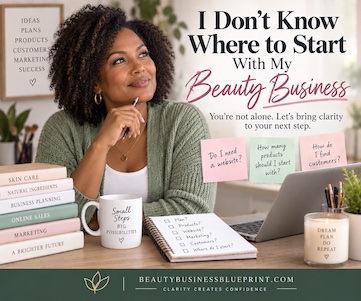
Starting a beauty business online? You have the idea. Maybe you’ve even had it for years.
You know you want to start a beauty business. Perhaps you’re an esthetician who wants to sell products online.
Maybe you’re an aromatherapist with formulas you’ve been creating for friends and clients. You might make soaps, body butters, hair oils, candles, fragrances or other handmade products.
Or maybe you simply have years of beauty knowledge and experience and know you’re ready to turn some of that knowledge into a business.
There’s just one problem:
You don’t know where to start.
And every time you try to figure it out, you seem to end up with even more things to do.
Someone tells you that you need a website.
Someone else says you should start on Instagram.
Then you hear that you need an email list.
A logo.
You need packaging.
An LLC.
You need a sales funnel.
You need to learn SEO.
And, You definitely need to make videos.
And, of course, now everyone is telling you that you need AI.
Before long, your original excitement about starting a beauty business has turned into a very long to-do list.
Here’s what I want you to understand:
You don’t have to do everything at once.
You simply need to know what comes first.
One of the biggest mistakes beginning beauty entrepreneurs make is assuming you need more information.
So you start collecting it.
Another YouTube video.
Another podcast.
A free download.
More webinars.
And definitely, another course.
Oh and, Another expert telling you how they built a six- or seven-figure business.
There is certainly nothing wrong with learning. In fact, learning will always be part of building a business.
But there comes a point when more information doesn’t create more clarity.
It creates overwhelm.
You don’t necessarily need another 47 things to add to your list.
You need a starting point.
This is where I see many aspiring beauty entrepreneurs get stuck.
They begin asking questions such as:
Which website platform should I use?
Should I use Shopify?
What email software should I buy?
Should I be on TikTok?
Do I need a Facebook page?
Should I create a YouTube channel?
What AI tools should I use?
Those questions matter eventually.
But they’re not necessarily your first questions.
Before you start choosing technology, you need to understand the business that technology is supposed to support.
Start with questions like:
-Who am I trying to help?
-What problem am I helping them solve?
-What am I going to sell?
-Why would someone choose my product or service?
-How will I reach the people who are most likely to need it?
Those answers become the foundation for many of the decisions that come later.
Let’s say you want to create natural skin care products.
That’s a beginning, but it’s still very broad.
Who are those products for?
Women with mature skin?
Women with melanin-rich skin who are concerned about uneven skin tone?
Teenagers experiencing oily skin and breakouts?
Busy professional women who want a simple skin care routine?
People with dry, sensitive skin?
Those are very different customers.
And they may require different products, different messaging and different ways of reaching them.
This is why knowing your ideal customer isn’t just a marketing exercise.
It helps you make better business decisions.
When you know who you’re trying to help, you can begin asking:
What does she need?
That’s a much better starting question than:
What can I make?
Beauty professionals love products.
That’s understandable.
You’re creative. You may enjoy working with ingredients, textures, essential oils, colors, fragrances and formulations.
So it’s very tempting to begin with the product.
You formulate six body butters.
Order 100 jars.
Have beautiful labels printed.
Create a logo.
Pay someone to build a website.
And then you arrive at the question that should have been asked much earlier:
Who am I selling this to?
That’s when marketing becomes difficult.
You’re trying to find a customer for something you’ve already created rather than creating an offer around a customer you’ve taken the time to understand.
The order matters.
The words business plan can make starting feel even more intimidating.
You might imagine complicated spreadsheets, financial projections and a thick document that looks as though it belongs in a banker’s office.
Your business planning can become more detailed as your business grows.
But at the beginning, you need clarity.
Try answering these five questions:
Don’t worry about making your answers perfect.
Write them down.
Seeing your thoughts on paper can reveal gaps that are difficult to see when everything is swirling around in your head.
Maybe you’re reading this thinking:
“It’s too late. I’ve already bought products.”
Or:
“I already paid for my website.”
That’s okay.
Starting out of order doesn’t mean you have to throw everything away and begin again.
It simply means it’s time to stop adding things for a moment and examine the foundation underneath what you’ve already built.
Ask yourself:
Do I clearly know who my customer is?
Does my product solve a specific problem or meet a specific desire?
Can I explain what makes my business different?
Do I know how I’m going to attract potential customers?
Do I have a way to continue communicating with people who aren’t ready to buy today?
If several of those answers are “no,” you’ve just discovered where some of your work needs to begin.
That’s useful information.
This is especially important today.
Social media allows us to see the polished version of everybody else’s business.
You see the beautiful packaging.
The professional videos.
The warehouse.
The thousands of followers.
The launch that supposedly generated thousands of dollars.
What you usually don’t see are all the steps that happened before that moment.
You don’t see the mistakes.
Nor do you see the product that didn’t sell.
You don’t see the website that had to be rebuilt.
You don’t see the money that was spent on things that didn’t work.
And you certainly don’t see every hour that went into building the business.
It isn’t Your job to reproduce someone else’s business.
Your job is to build your business in the right order.
This is especially important if you’re coming into entrepreneurship later in life or after years of working in the beauty industry.
You may be looking at all the new technology and thinking you’re behind.
But you may have something the newest technology can’t manufacture overnight:
experience.
Perhaps you’ve worked with clients for 10, 15 or 20 years.
You’ve listened to their questions.
You know what confuses them.
You’ve watched them struggle with certain problems.
You know what they repeatedly purchase.
You know what they ask when nobody else is listening.
Don’t discount that knowledge because you haven’t figured out Instagram or built your website yet.
Your experience can help you identify a customer need.
Technology can then help you deliver the solution.
That’s a very different way of approaching an online business.
There is tremendous pressure online to move fast.
Launch this weekend.
Make your first $10,000 in 30 days.
Post three times a day.
Build seven income streams.
Automate everything.
But speed without clarity can become expensive.
There is nothing wrong with taking the time to understand what you’re building before you begin spending heavily to build it.
That doesn’t mean remaining in the planning stage forever.
It means taking the next appropriate step instead of trying to take 20 steps at once.
Your first goal doesn’t have to be creating an empire.
Your first goal can simply be:
Get clear.
Then move.
Learn from what happens.
Adjust.
And take the next step.
Start with your foundation.
Before worrying about whether you need another social media platform, another piece of software or another product, make sure you understand the core elements of the business you’re trying to create.
Who is your customer?
How will she find you?
What does she need?
How will you position it?
What are you offering?
How will you communicate with her?
How will you turn interest into a sale?
Those aren’t glamorous questions.
But answering them can save you an enormous amount of frustration, time and money later.
And that’s exactly why I created the 9 Core Elements to Help You Get Started Selling Beauty Products Online.
It’s not designed to give you another pile of information to consume.
It’s designed to help you think through your business.
You’ll work through the fundamental questions that can help you identify what you already know, what you still need to figure out and what deserves your attention next.
Because when you’re saying:
“I don’t know where to start,”
the answer isn’t to start everywhere.
It’s to start with the foundation.
Ready to Find Your Starting Point?
Download your free copy of 9 Core Elements to Help You Get Started Selling Beauty Products Online and begin working through your business one element at a time.
GET THE 9 CORE ELEMENTS — FREE
Beauty Business Blueprint — Because Clarity Creates Confidence.
That’s it for this week,
Honor Your Craft. Build Your Online Business.
Juliette
Where Beauty and Business Meet.
Healthy body, healthy business. When you’re building a beauty business, it’s easy to spend your days thinking about products, clients, content, social media, websites, sales and everything else that comes with being an entrepreneur.
But there’s another part of your business that deserves just as much attention.
You.
Not long ago, I was reminded of this in a very personal way.
I injured my knee while hula hooping. I wasn’t doing anything reckless. I was actually trying to stay active and take care of myself. But the movement aggravated a sciatic nerve issue that I had already been working through for about a year.
Then I learned that I was also beginning to deal with anemia.
Suddenly, my body was asking for a different kind of attention.
And that’s something I believe every beauty entrepreneur needs to understand:
You cannot separate the health of the entrepreneur from the health of the business.
When you’re responsible for your own business, there’s always something else you could be doing.
One more email.
One more product description.
One more social media post.
One more order to prepare.
One more video to record.
One more idea to research.
Before you realize it, you’ve been sitting at your computer for hours. You haven’t stretched. You haven’t had enough water. You haven’t eaten properly. And although you promised yourself you would get to bed earlier tonight, you’re still working long after you should have shut everything down.
Sound familiar?
I’ve certainly had to look at some of these habits myself.
I still maintain healthy eating habits. I generally eat one main meal a day and reach for fruit when my sweet tooth starts calling.
But sleep?
That’s still a work in progress.
I’m learning that taking care of yourself isn’t something you finally get around to after you’ve finished building your business.
It has to become part of how you build the business.
One of the biggest lessons I’ve learned is that our bodies communicate with us constantly.
Sometimes the message is fatigue.
Sometimes it’s stiffness after sitting too long.
Sometimes it’s discomfort that tells you you’ve overdone something.
Sometimes it’s simply realizing that your energy isn’t what it normally is.
The challenge for entrepreneurs is that we’re very good at saying:
“I’ll deal with it later.”
Later can easily become next week, next month or next year.
We learn to push through because we’re trying to meet a deadline, launch a product or generate income.
But your body doesn’t understand your marketing calendar.
It simply responds to what you’re asking it to do.
Pay attention to those early signals and, when something persists or changes, get appropriate medical guidance rather than trying to diagnose or push through it yourself.
My knee injury happened while exercising, but that doesn’t mean the lesson is to stop moving.
The lesson is to learn what kind of movement your body needs right now.
There may be seasons when you can handle vigorous workouts. There may be other seasons when walking, gentle stretching, yoga or physical therapy exercises recommended by your healthcare professional are more appropriate.
Don’t compare today’s body with the body you had ten or twenty years ago—or even last year.
Work with the body you have today.
If you spend hours working at a desk, consider building small movement breaks into your workday. Stand up. Walk around the room. Stretch. Step outside for a few minutes.
Five or ten minutes away from the computer is not going to destroy your productivity.
It may actually improve it.
Healthy eating doesn’t have to become another complicated project.
Think about nourishment rather than perfection.
Your body needs adequate protein, carbohydrates, healthy fats, vitamins, minerals and hydration to function properly. If you’ve been told you have a nutritional deficiency or anemia, work with your healthcare professional to understand what your particular body needs rather than assuming food or supplements alone will correct it.
Create simple habits that fit your lifestyle.
Keep fruit available instead of automatically reaching for sweets. Keep water nearby while you’re working. Plan meals before you’re exhausted and hungry. Choose foods that nourish you and that you actually enjoy eating.
And remember that “healthy” doesn’t necessarily mean eating less.
It means giving your body what it needs.
This is the area where I’m still talking to myself.
Going to bed at a reasonable hour sounds simple until you’re an entrepreneur with another idea running through your head at midnight.
But sleep isn’t wasted time.
It’s maintenance.
We wouldn’t expect our computers, phones or equipment to operate indefinitely without recharging them. Yet entrepreneurs sometimes expect exactly that from themselves.
Try establishing a time when the business closes for the evening.
Write tomorrow’s priorities down so your brain doesn’t have to keep rehearsing them.
Dim the lights.
Step away from the screen.
Create a simple nighttime ritual that signals:
Today’s work is finished.
The business will still be there tomorrow.
Don’t leave your health to whatever time remains after work.
Put it on the schedule. Make ” healthy body, healthy business” your mantra
Your daily wellness regimen might include:
None of these things sound revolutionary.
That’s the point.
Healthy living is usually built from small things practiced consistently.
We talk a lot about business plans, marketing plans, content plans and financial plans.
Perhaps we also need a personal wellness plan. After all, a healthy body can definitely contribute to a healthy business.
Ask yourself:
What habits will help me remain physically and mentally capable of running the business I’m trying so hard to build?
Because success isn’t simply about reaching a revenue goal.
It’s being well enough to enjoy what you’ve created.
My recent experiences with my knee, my sciatic nerve and the early signs of anemia have reminded me that ambition and self-care cannot live in separate worlds.
I’m still learning.
I’m still adjusting.
And yes, I’m still working on getting myself into bed at a decent hour.
But that’s part of the journey too.
As beauty professionals, we spend so much time helping other people feel better, look better and care for themselves.
We deserve to practice some of that same care in our own lives.
Build your business.
Create your products.
Serve your clients.
Write the book.
Record the podcast.
Launch the website.
Dream big.
But while you’re building everything else, remember to take care of the person doing the building.
Your body isn’t an interruption to your business plan.
Your body is part of the plan.
That’s it for this week,
Honor Your Craft. Build Your Online Business.
Juliette
Beauty Business Blueprint
Where Beauty and Business Meet.
“Essential oils are some of nature’s most remarkable gifts, but they’re also among the most misunderstood ingredients in the beauty industry. As a beauty entrepreneur, understanding how to use them safely is just as important as knowing how to use them creatively.”
Essential oils have become increasingly popular in skin care, body care, hair care, soaps, candles, and natural perfumes. Consumers are drawn to their beautiful aromas and appreciate the botanical story behind many handmade beauty products.
As an aromatherapist and beauty entrepreneur, I’ve seen firsthand how essential oils can elevate a product when they’re used with knowledge and care.
Unfortunately, I’ve also seen well-meaning entrepreneurs believe that because an ingredient is “natural,” it must automatically be safe.
That simply isn’t true.
Essential oils are highly concentrated plant extracts. Some require hundreds—or even thousands—of pounds of plant material to produce a relatively small amount of oil. Their potency is what makes them so valuable, but it’s also why they must be handled responsibly.
Whether you’re creating facial serums, body butters, soaps, perfumes, or massage oils, understanding essential oil safety is one of the most important investments you can make in your business.
Safe products build trust.
Trust builds loyal customers.
Let’s explore the essential safety practices every beauty entrepreneur should know.
One drop of essential oil contains a remarkable concentration of naturally occurring chemical constituents.
That concentration is why essential oils are widely used in aromatherapy and personal care products.
However, more is not necessarily better.
Using excessive amounts of essential oils can increase the risk of:
Many new formulators mistakenly assume that adding extra essential oil will make a product more effective or luxurious.
In reality, thoughtful formulation almost always produces a better product than simply increasing the fragrance level.
One of the most important principles in essential oil safety is proper dilution.
Essential oils should rarely be applied directly to the skin without careful consideration, and they are generally incorporated into carrier oils, creams, lotions, or other cosmetic bases.
Different products call for different usage rates.
For example:
Learning recommended usage levels for each essential oil—and for each type of product—is a hallmark of a responsible formulator.
When in doubt, less is often more.
Choosing essential oils should never be based solely on fragrance.
Each oil has its own aromatic profile, skin considerations, and formulation characteristics.
For example:
Think beyond scent.
Ask yourself:
Professional formulation always begins with purpose.
One topic that deserves special attention is phototoxicity.
Certain citrus essential oils can increase the skin’s sensitivity to ultraviolet (UV) light if they are used above recommended levels in leave-on products.
This means that a product applied before sun exposure could increase the risk of skin irritation or discoloration.
Not every citrus oil presents the same level of concern, and processing methods can affect phototoxicity. Understanding the specific properties of each oil is an important part of responsible formulation.
If you’re creating products that are designed to remain on the skin, research phototoxicity carefully and formulate accordingly.
Your customers are trusting you with their skin.
Essential oils can change over time.
Exposure to:
can accelerate oxidation, reducing the quality of the oil and potentially increasing the likelihood of skin irritation.
Store essential oils in:
Label every bottle with:
Good storage practices help preserve both quality and consistency.
The quality of your finished product depends on the quality of your ingredients.
Choose suppliers who provide:
Low-cost essential oils that lack documentation may not provide the consistency or quality you need for professional product formulation.
Quality ingredients contribute to customer confidence.
Even thoughtfully formulated products may not be suitable for every individual.
People have different skin sensitivities, allergies, and medical conditions.
Encouraging customers to perform a simple patch test before using a new product demonstrates professionalism and care.
It also reinforces that skin care is personal.
One product does not work identically for everyone.
Helping customers understand this builds trust rather than unrealistic expectations.
Clear labeling is an important part of product safety.
Include information such as:
Well-written labels answer questions before customers have to ask them.
They also reflect the professionalism of your brand.
Essential oil research continues to evolve.
New information becomes available regarding formulation practices, ingredient interactions, and consumer safety.
As beauty entrepreneurs, we have a responsibility to continue learning.
Invest in books.
Take formulation courses.
Study cosmetic science.
Expand your understanding of carrier oils, botanical extracts, preservatives, emulsifiers, and ingredient compatibility.
Education protects both your customers and your business.
One of the greatest compliments your customers can give you isn’t, “Your products smell amazing.”
It’s:
“I trust your products.”
That trust comes from thoughtful formulation, honest education, responsible labeling, and a genuine commitment to customer well-being.
Beautiful branding may attract a first purchase.
Safe, reliable products encourage customers to return again and again.
Every jar, bottle, and serum you create represents your brand.
When customers choose your products, they’re placing their confidence in your knowledge and professionalism.
That’s a responsibility worth taking seriously.
By understanding essential oil safety, investing in quality ingredients, and continuing your education, you’re doing more than creating beautiful products.
You’re building a business based on integrity.
And in today’s beauty industry, integrity is one of the most valuable ingredients you can offer.
Whether you’re an aromatherapist, esthetician, handmade beauty artisan, or aspiring beauty entrepreneur, remember this:
The goal isn’t simply to create products people enjoy.
The goal is to create products they can trust.
That’s how lasting beauty brands are built.
If you’re serious about creating and selling natural beauty products online, begin with a business strategy that supports your creativity.
Selling Beauty Products Online: The 9 Core Elements to Help You Get Started.
Inside, you’ll discover the essential business principles that help beauty entrepreneurs move beyond product making and begin building brands that educate, inspire, and serve customers with confidence.
Your knowledge is one of your greatest business assets. Build your brand on it.
That’s it for this week,
Honor Your Craft.
Build Your Online Business.
Juliette Samuel,
Where Beauty and Business Meet.
Have you ever wondered if you’re too late to start a beauty business?Perhaps you’ve spent years working as an esthetician, creating handmade beauty products, studying aromatherapy, or simply developing a passion for beauty and wellness. Now you’re seeing others build brands online and wondering if there’s still room for you.
The answer is yes.
In fact, building a beauty brand after 40 may give you advantages that many younger entrepreneurs simply don’t have.
While social media often celebrates youth, the beauty industry is filled with consumers looking for something much more valuable: experience, expertise, and authenticity.
If you’ve been considering launching a beauty brand, selling products online, or turning your knowledge into a business, now may be the perfect time to begin.
One of the greatest assets mature entrepreneurs bring to the marketplace is experience.
By the time you reach your 40s, 50s, or beyond, you’ve likely spent years developing skills that directly translate into business success.
You understand how to communicate with people and how to solve problems. You have life experience that helps you navigate challenges and make better decisions.
If you’ve worked with clients, developed products, or helped others improve their skin, hair, or overall well-being, you’ve already built a foundation of knowledge that customers value.
The beauty industry doesn’t need more people trying to go viral.
It needs more trusted experts.
Consumers are increasingly seeking knowledgeable professionals who can provide real solutions instead of simply following trends. That’s You!
Today’s consumers are more informed than ever.
Before making a purchase, many people spend hours researching products, reading reviews, and looking for educational content.
This creates a tremendous opportunity for beauty entrepreneurs like you, who are willing to teach.
Whether your expertise involves skincare, natural beauty, aromatherapy, handmade products, or wellness practices, your knowledge can become one of your most powerful marketing tools.
Educational content helps potential customers get to know you before they ever make a purchase.
It demonstrates your expertise and establishes trust.
When people trust your recommendations, they’re far more likely to buy from you when they’re ready to invest in products or services.
One advantage mature entrepreneurs often overlook is the power of their personal story.
Your experiences have shaped who you are.
Perhaps you’ve overcome challenges with your own skin.
Maybe you’ve spent years perfecting handcrafted products.
Perhaps you’ve worked in the beauty industry and noticed gaps that inspired you to create better solutions.
Stories create connections.
Customers don’t just buy products—they buy into the people and missions behind those products.
Sharing your journey allows potential customers to see themselves in your story.
It transforms your business from just another brand into something meaningful and memorable.
Many of you believe you need a massive social media following before you can launch a successful business.
The reality is quite different.
A small audience of engaged followers who trust you can be far more valuable than a large audience that barely knows you.
Instead of focusing solely on follower counts, focus on building relationships.
Answer questions.
Share insights.
Offer helpful tips.
Provide solutions.
When you consistently deliver value, the right audience will naturally begin to gather around your brand.
And those people are often your future customers.
One of the biggest mistakes you make as new beauty entrepreneurs, is spending all of your time creating products while neglecting audience building.
You perfect formulations.
You design labels.
As well as, launch websites.
Then you discover that no one knows they exist.
A more effective approach is to build your audience while you’re building your products.
Start sharing your expertise now.
Create helpful content.
Begin collecting email subscribers.
Have conversations with potential customers.
An audience is one of the most valuable assets your business can own because it gives you direct access to people who are interested in what you have to offer.
Many of you have dozens of ideas.
While creativity is wonderful, clarity is often more profitable.
Instead of trying to solve every beauty concern, start by focusing on one.
For example:
When people clearly understand what you help them achieve, your brand becomes easier to remember and recommend.
Specialization creates authority.
Authority builds trust.
Trust leads to sales.
Years ago, starting a beauty business often required significant capital, retail partnerships, and access to physical storefronts.
Today, the internet has changed the playing field.
You can educate customers through:
You can build relationships with customers around the world from your home office.
The opportunities available today would have been unimaginable just a few decades ago.
But success still requires a plan.
Products can be copied.
Brands cannot.
Your brand is the experience, reputation, and emotional connection people have with your business.
It’s your story.
It’s your mission.
Your values.
Your voice.
And, Your customer experience.
When customers connect with your brand, they often become loyal supporters who return again and again.
That’s why successful beauty entrepreneurs focus on creating brands rather than simply selling products.
If you’ve been waiting for the perfect time to start your beauty business, consider this your reminder.
You are not behind.
You are not too old.
And you have not missed your opportunity.
The beauty industry needs experienced voices.
It needs women who understand customers.
It needs professionals who are willing to share what they’ve learned.
Your age is not a disadvantage.
It may be your greatest business advantage.
Starting a beauty business online can feel overwhelming when you’re trying to figure out where to begin.
That’s exactly why I created my free guide:
This practical workbook is designed to help aspiring beauty entrepreneurs gain clarity before investing time, money, and energy into building their businesses.
Inside, you’ll work through key questions about:
Think of it as your first step toward turning your beauty business idea into a clear, actionable plan.
Download your free copy today and begin building the foundation for a beauty brand that reflects your expertise, your experience, and your vision for the future.
Because your best business years may still be ahead of you.
That’s it for this week,
Honor Your Craft. Build Your Online Business.
Juliette Samuel,
Where Beauty and Business Meet.
If you’ve been thinking about making, or making and selling handmade beauty products — whether that’s a luxurious body butter, an artisan soap, or a custom face serum — you’ve probably heard rumblings about new regulations.
Did someone in a Facebook group mentioned it? Maybe a fellow maker warned you. Maybe you Googled it at midnight and ended up more confused than when you started.
Here’s the thing, something genuinely did change. And if you sell cosmetics in the United States — handmade or otherwise — it affects you.
The good news? It’s not as overwhelming as it sounds. And You, the artisans, who understand these changes are the ones who’ll build businesses that last.
Let’s break it down.
In December 2022, Congress passed the Modernization of Cosmetics Regulation Act — known as MoCRA. It was signed into law as part of the Consolidated Appropriations Act and represents the most significant update to cosmetics regulation in the United States in over 80 years.
That’s not an exaggeration. The previous major legislation governing cosmetics dated back to 1938. For decades, the beauty industry — including the booming handmade and indie segment — operated under rules that were written before television existed.
Go Figure!
MoCRA changed that. And while large corporations have entire compliance departments to absorb these changes, independent artisans and home-based/handmade beauty businesses are often left navigating them alone.
That’s exactly why we need to talk about it.
The most significant update to cosmetics regulation in over 80 years — and most handmade, home-based and small beauty business artisans have never heard of it.
MoCRA introduced several new requirements that apply across the cosmetics industry. Here’s what matters most for small and home-based beauty businesses:
1. Facility Registration. Businesses that manufacture or process cosmetic products are now required to register their facilities with the FDA. There is a small business exemption for companies below certain gross sales thresholds — but those thresholds can be updated, so it’s critical to verify your current status directly with the FDA or a qualified compliance professional rather than relying on secondhand information.
2. Product Listing. Even if you qualify for a facility registration exemption, you may still be required to submit a product listing to the FDA. This involves providing basic information about each product you sell — its name, the company behind it, and the ingredients it contains.
3. Safety Substantiation. This is one of the most important new requirements. MoCRA formally requires that cosmetic products be safe for their intended use. For artisans, this means having a reasonable, documented basis for the safety of your formulations — not just a good feeling about your ingredients. Sourcing from reputable suppliers, keeping clear records, and understanding your formulations are all part of this.
4. Labeling Compliance. Your product labels must meet FDA standards — and this goes beyond just listing ingredients. The order matters (ingredients must be listed by descending weight), required warnings must be included, and the claims you make about your product must stay within cosmetic territory. More on that below.
5. Adverse Event Reporting. This is a brand-new requirement with real teeth. If a customer experiences a serious adverse event — such as a significant allergic reaction — and reports it to you, you now have 15 business days to report that to the FDA. This requirement did not exist before MoCRA. If you’ve been selling for a while and didn’t know this, now you do.
Here’s where a lot of well-meaning artisans unknowingly get into trouble — and it’s not about their formulations. It’s about their words.
Under FDA regulations, the difference between a cosmetic and a drug comes down to the claims you make about your product. A cosmetic is something that cleans, beautifies, or alters appearance. A drug affects the structure or function of the body.
Sounds simple enough. But consider these examples:
“Moisturizes and softens skin” → cosmetic claim. You’re fine.
“Treats dry skin conditions” → drug claim. Your product may now be classified as a drug.
“Adds shine and smooths the hair cuticle” → cosmetic claim. Fine.
“Repairs hair damage at the cellular level” → potentially a drug claim. Problem.
This isn’t just about your label. It applies to your Etsy listing description, your Instagram captions, your website copy, your YouTube video titles — anywhere you describe what your product does.
You can have a perfectly formulated, beautifully packaged product and still run into regulatory trouble — because of a single word choice in your marketing copy.
The safest approach is to describe what your product does on the surface — how it feels, how it looks, the sensory experience — rather than making claims about what it does inside the body. When in doubt, err on the side of caution and consult a cosmetic regulatory professional before publishing.
MoCRA was written with the understanding that not every cosmetics business is Estée Lauder. There are exemptions and tiered requirements designed to make compliance achievable for small businesses.
But “achievable” is not the same as “optional.”
The artisans who will thrive in this new regulatory environment are the ones who treat compliance as part of their brand — not an obstacle to it. And honestly? There’s a real competitive advantage here. When your customers know that you take your craft seriously, that you’ve done the work to understand what goes into your products and how they’re sold, it builds the kind of trust that no Instagram ad can manufacture.
Here are the most practical places to start:
Know your INCI names. Every ingredient you use should be identifiable by its INCI name — the International Nomenclature of Cosmetic Ingredients. This is what goes on your label, in the correct order. If your supplier can’t provide this, find a supplier who can.
Keep records. Document your sourcing, your formulations, and any customer feedback. Good records aren’t just good business — they’re your first line of defense if you ever face a regulatory inquiry.
Audit your labels before you launch anything new. Your label is a legal document. Treat it accordingly. Review it against current FDA guidelines, and don’t assume what worked two years ago is still compliant today.
Stay current. MoCRA is still being implemented, and the FDA continues to release new guidance. Subscribe to FDA updates or follow trusted industry organizations so you’re not caught off guard.
Running a home-based beauty business has always required wearing a lot of hats. Formulator. Photographer. Marketer. Customer service rep. Shipper.
MoCRA just added one more hat to the rack: compliance-aware business owner.
It’s not the most glamorous part of the job. But it is one of the most important — and the most empowering, once you understand it. Because when you know the rules, you can build with confidence. You can scale without fear. You can put your products in the hands of customers knowing you’ve done everything right.
That’s not a burden. That’s a foundation.
And that foundation is exactly what I cover in depth in my book — Selling Beauty Products Online: How To Turn Your Passion For Beauty Products Into An Online Business. From FDA basics and MoCRA compliance, to labeling, pricing, building your store, and marketing your brand. It’s everything you need to go from passionate maker to confident business owner.
If you’re ready to take that next step, the link is below.
You’ve already got the talent. Now let’s make sure you’ve got the knowledge to back it up.
Ready to go deeper? Check out pages 44-57 in the book.
Selling Beauty Products Online: How To Turn Your Passion For Beauty Products Into An Online Business covers FDA compliance, MoCRA, labeling, pricing, building your online store, and everything in between — written specifically for independent beauty artisans.
That’s it for this week,
Honor Your Craft. Build Your Online Business.
Juliette Samuel,
Where Beauty and Business Meet.
The beauty industry is no longer driven only by massive corporations, celebrity brands, or department store counters. Today’s consumers are actively searching for something more personal, more intentional, and more connected to wellness, authenticity, and trust.
That shift creates a major opportunity for aromatherapists, estheticians, and handmade beauty artisans.
While many independent beauty professionals assume they are “small players” in a massive industry, the data tells a very different story. Consumer buying habits are evolving rapidly, and the beauty industry increasingly depends on specialists, educators, wellness-focused creators, and niche beauty brands to meet changing customer needs.
Your experience, knowledge, craftsmanship, and ability to connect personally with clients are becoming some of the most valuable assets in modern beauty commerce.
The global beauty and personal care industry is projected to reach hundreds of billions of dollars in revenue over the next several years. Industry reports from organizations like McKinsey & Company, Statista, and Grand View Research continue to show strong growth across skincare, wellness beauty, fragrance, natural beauty products, and self-care categories.
But one of the most important shifts happening inside the industry is this:
Consumers are moving away from one-size-fits-all beauty.
People want:
This is where independent beauty professionals shine.
Large corporations may dominate advertising budgets, but smaller beauty businesses often dominate trust, authenticity, and personal connection.
Modern consumers are more educated than ever before. Many spend hours researching ingredients, watching skincare tutorials, reading labels, and learning about wellness before making purchases.
That means expertise matters.
Estheticians understand skin concerns in real-world settings. Aromatherapists understand how scent, wellness, and emotional support connect. Handmade beauty artisans understand ingredients, formulation, craftsmanship, and customization.
These are not small skills.
These are specialized forms of knowledge consumers are actively searching for online every day.
The rise of educational beauty content on platforms like YouTube, Instagram, and Pinterest proves that people are no longer buying products blindly. They want guidance from someone they trust.
That creates enormous opportunities for independent beauty professionals willing to educate, teach, and build an online presence.
Beauty is no longer viewed only as makeup or skincare.
Today, beauty overlaps with:
This is especially important for aromatherapists and handmade wellness brands.
Consumers increasingly view products like essential oil blends, body oils, bath rituals, botanical skincare, and wellness fragrances as part of a broader self-care lifestyle rather than simple cosmetic purchases.
According to industry trend reports from NIQ (NielsenIQ) and Circana, consumers continue to spend on products tied to comfort, emotional wellness, and daily rituals even during uncertain economic periods.
That means smaller wellness-centered beauty businesses are operating in a category with long-term consumer demand.
There is a growing consumer desire for products that feel:
Handmade beauty artisans fill this gap beautifully.
Many customers are becoming overwhelmed by mass-market products containing complicated ingredient lists and aggressive marketing claims. Independent makers often offer something simpler and more transparent.
Consumers increasingly appreciate:
This is one reason storytelling has become so important in beauty marketing.
Your journey, philosophy, process, and passion are not “extra” parts of your business. They are often the reason customers choose you over a larger competitor.
Estheticians hold one of the strongest positions in today’s beauty industry because they combine practical experience with client education.
Consumers are actively searching online for answers to concerns like:
People want trustworthy guidance from someone with hands-on experience.
This creates opportunities to:
Many successful beauty businesses today are built around education first and products second.
The professional who teaches often becomes the professional consumers trust enough to buy from.
Years ago, launching a beauty brand required major funding, retail partnerships, or department store distribution.
Today, independent beauty professionals can build businesses online using:
This is one of the biggest changes in the beauty industry.
You no longer need permission from a large retailer to build a beauty brand.
You need:
Small beauty businesses now have tools that were once only available to large corporations.
One of the most overlooked trends in the beauty industry is the shift toward trust-based buying.
Consumers are becoming more skeptical of:
Instead, many are seeking creators and professionals who feel real, knowledgeable, approachable, and authentic.
That is excellent news for independent beauty professionals.
Your experience working directly with clients gives you insights that algorithms and large corporations cannot easily replicate.
When you share:
…you position yourself as a trusted authority rather than just another seller online.
Aromatherapists, estheticians, and handmade beauty artisans are not sitting on the sidelines of the beauty industry.
You are part of the movement shaping where beauty is going next.
The future of beauty is becoming:
And those trends align perfectly with what independent beauty professionals already do best.
The beauty industry does not only need large brands.
It needs educators.
>It needs formulators.
>It needs wellness advocates.
>It needs specialists.
>It needs creators with real experience and genuine passion.
Most importantly, it needs businesses that make people feel seen, supported, and cared for.
That is the true power of independent beauty entrepreneurship in today’s digital world.
You already have the expertise.
Now it’s time to learn how to position that expertise online in a way that attracts the right audience and creates long-term business growth.
Start by reading:
Your Beauty Expertise Is a Billion-Dollar Opportunity — The Market Is Ready. Are You?
And if you’re just getting started, be sure to download our free guide designed specifically for estheticians, aromatherapists, and handmade beauty artisans who want to begin selling beauty products online with more clarity and confidence.
That’s it for this week,
Honor Your Craft. Build Your Online Business.
Juliette Samuel,
Where Beauty and Business Meet.
Aromatherapist online? The internet has opened new opportunities for you, aromatherapists, to share your knowledge, connect with a larger audience, and create multiple streams of income beyond one-on-one services or local sales.
Many you already possess valuable expertise in essential oils, wellness rituals, natural living, and emotional well-being. The challenge is often not a lack of knowledge, it’s understanding how to package that knowledge into an online business.
The good news is that you do not need to become a loud influencer or complicated marketer to begin earning online. You can start small, grow steadily, and build income around the skills and interests you already have.
Below are five realistic ways, you as aromatherapists, can begin earning income online while staying aligned with your passion for wellness and holistic living.
One of the easiest ways to begin earning online is by turning your existing knowledge into digital products.
A digital product is something customers can download instantly after purchase. Unlike physical inventory, there is no shipping, packaging, or storage involved.
Examples of Digital Products for Aromatherapists
Many people are actively searching online for natural wellness solutions, and they appreciate guidance from someone knowledgeable and trustworthy.
Even simple resources can become valuable income-generating products when presented clearly and professionally.
Digital products allow you to earn repeatedly from knowledge you create once.
They also:
You do not need to create a large course immediately. A small downloadable guide can be the perfect starting point.
Affiliate marketing is one of the most overlooked income streams for aromatherapists.
With affiliate marketing, you earn a commission when someone purchases a product through your recommendation link.
Examples of Affiliate Opportunities
The key is authenticity.
Your audience is more likely to trust recommendations that feel natural and genuinely useful rather than overly promotional.
You can share recommendations through:
For example, you might create content such as:
This style of content blends education with income generation in a way that feels helpful rather than sales-focused.
People are increasingly looking for guided learning experiences online, especially in wellness and self-care spaces.
Teaching workshops allows aromatherapists to turn their expertise into interactive educational experiences.
Workshop Ideas for Aromatherapists
These workshops can be:
Why Workshops Work
Workshops help:
Many people prefer learning directly from a real person rather than searching through random online information.
Your personal experience and teaching style become part of the value.
Social media can help people discover you, but email marketing helps you build a more stable business.
An email list gives you direct access to your audience without depending entirely on changing algorithms.
What Aromatherapists Can Share Through Email
Email builds trust over time.
People may follow you on social media casually, but subscribers who join your email list are usually more invested in your content and recommendations.
A simple weekly email can help:
Easy Ways to Start Building a List
Offer a free resource such as:
This encourages visitors to subscribe while introducing them to your expertise.
Many aromatherapists believe social media requires dancing, trends, or constant personal exposure.
It doesn’t.
Today, educational and interest-based content performs extremely well, especially in wellness categories.
Content Ideas for Aromatherapists
Your Goal Is Positioning
Social media positioning simply means becoming known for a specific topic.
Over time, your audience begins associating you with:
This positioning builds familiarity and trust, which eventually supports:
You Do Not Need a Massive Audience
A smaller audience that trusts you is often more valuable than a large audience that feels disconnected.
Consistency and clarity matter more than perfection.
Many aromatherapists already have valuable knowledge that people are actively searching for online.
The missing piece is often understanding how to package that knowledge into:
You do not need to build everything at once.
Start with one platform, one offer, or one simple resource.
Over time, small consistent efforts can grow into an online business that supports both your creativity and your income goals.
The internet has created space for educators, wellness creators, and niche experts to build meaningful businesses around what they already know.
For aromatherapists, that opportunity is growing every day.
That’s it for this week,
Honor Your Craft. Build Your Online Business.
Juliette Samuel,
Where Beauty and Business Meet.
Beauty Expertise. Published on Beauty Business Blueprint
There’s a quiet revolution happening in beauty and it’s being led not by corporate giants, but by people like you.
Estheticians who formulate your own facial serums. Aromatherapists who blend therapeutic oils with the precision of a scientist and the soul of an artist. Handmade beauty artisans who pour your knowledge, passion, and intention into every batch of whipped body butter, botanical toner, and handcrafted soap.
The market is ready. The numbers prove it. And this article is going to show you exactly why now is the most powerful time in history to turn your craft, and expertise into a thriving online beauty business.
Let’s start with the landscape, because when you understand the size of the opportunity, fear starts to look a lot like excitement.
The global beauty and personal care market was valued at $646.2 billion in 2024, and is projected to reach $821.4 billion by 2032. That’s not a niche. That’s an industry larger than the GDP of most countries on the planet.
But here’s what matters most for you: the digital shift is where the real story lives.
Online beauty sales surged 14.1% in a single year, helping push the overall beauty market to $104.9 billion in the U.S. alone. Even more telling — 41% of all beauty and personal care sales now happen through e-commerce. Nearly half the market has moved online, and it’s still accelerating.
McKinsey’s State of Beauty 2025 report projects that by 2030, online channels will account for nearly one-third of all global beauty sales. This is the highest share of any single sales channel. The window isn’t closing. It’s opening wider every year.
Here’s where it gets really interesting, especially for natural beauty makers.
The clean beauty market — the space that lives and breathes the values of ingredient transparency, non-toxic formulations, and sustainable sourcing — was valued at $9.21 billion in 2025, and is on track to reach $37.49 billion by 2035, growing at a remarkable 15.2% annually.
To put that in perspective: while the broader beauty industry grows at about 5% per year, clean beauty is growing at three times that rate.
And consumers aren’t just curious, they’re committed. Sixty-three percent (63%) of beauty consumers say clean ingredients are extremely or very important when selecting a product. Nearly 68% of consumers say they specifically want skincare made with clean ingredients. That’s not a trend. That’s a movement with market share behind it.
North America is leading this charge, accounting for 34.7% of the global clean beauty market — making the U.S. one of the most fertile grounds in the world to launch an ingredient-conscious beauty brand.
As an esthetician, aromatherapist, or handmade beauty artisan, you are already making what consumers are desperately searching for. You don’t have to “pivot” to clean beauty, you “are” clean beauty.
Understanding your customer is the foundation of every successful beauty business. So let’s look at who is spending and what they actually want.
Millennials , those born between 1981-1996, are currently the most powerful force in online beauty, driving $16.7 billion in online beauty sales, the highest of any generation. They are brand-conscious, values-driven, and increasingly loyal to indie and small-batch brands that align with their lifestyle.
Gen Z (1997-2012) is close behind, spending an average of $342 per year on beauty products — a figure that’s only growing. What’s striking about this group: 43% of Gen Z consumers prefer direct-to-consumer beauty brands over traditional retail. They want to buy from the maker, not the middleman.
And across generations, one trend is reshaping the industry: personalization. A full 75% of consumers say they’d pay more for a personalized shopping experience. Among Gen Z specifically, 7 in 10 would pay at least 10% more for that personalized touch.
Think about what that means for you. Your story, your process, your formulation expertise — these aren’t just marketing assets. They are the personalized experience that consumers are willing to pay a premium for.
If you’re not yet selling — or at least showing up — on social media platforms, you’re leaving real money on the table.
37% of consumers discover new cosmetic brands through social media ads, and platforms like TikTok have fundamentally transformed the beauty buying journey. In the U.S., health and beauty products now account for approximately 80% of TikTok Shop sales, totaling $1.34 billion in 2024 alone.
The clean beauty hashtag had 1.3 billion views on TikTok — not followers, views. People are actively searching for products like yours. The question is whether they find you when they look.
For estheticians, aromatherapists, and handmade beauty artisans, social media isn’t just a selling platform — it’s an education platform. Sharing your knowledge about ingredients, your formulation process, or the benefits of essential oils builds trust before the transaction. It turns browsers into believers, and believers into buyers.
If you’re creating facial serums, body oils, botanical toners, or any skin-focused products, you’re working in the most dominant segment of the entire beauty market.
Skincare accounts for 40–42% of the global beauty market, making it the largest single category — valued at over $180 billion globally. Skincare is the clear segment leader regardless of which research firm you consult, and it’s where ingredient-conscious consumers are most focused.
The aromatherapy market deserves its own spotlight here. Essential oils and botanical ingredients are no longer alternative — they’re mainstream. Essential oil usage in cosmetics has grown 20% in recent years, and the wellness-meets-beauty crossover is one of the most discussed macro trends in McKinsey’s 2025 beauty report.
Body care is also having a major moment: prestige body products grew 25% in a single year, with 17% more buyers entering that segment in 2024 compared to the year before. If you make body butters, body scrubs, or botanical body oils, the market is expanding around you in real time.
The data paints a clear picture, but data only matters when it changes behavior. So what does all of this mean practically?
Your expertise is your edge. In a market saturated with mass-produced products, your training — whether as a licensed esthetician, a certified aromatherapist, or a self-taught artisan with deep ingredient knowledge — is a differentiator that major brands cannot replicate. Lead with it.
Your online store is your most important storefront. With nearly half of all beauty sales happening online, a well-built e-commerce presence isn’t optional — it’s essential. Whether you use Shopify, Etsy, or a standalone website, your digital storefront needs to communicate your story, your ingredients, and your expertise clearly and compellingly.
Transparency is currency. Consumers are actively reading ingredient labels, researching formulations, and fact-checking brand claims. The more open and honest you are about what’s in your products and why, the more trust you build — and in the clean beauty space, trust converts to sales.
Community over audience. The brands winning in this space aren’t just selling to customers — they’re building communities. Email lists, behind-the-scenes content, educational posts, and loyalty programs all create the kind of sticky relationship that keeps customers coming back and referring friends.
Here’s the honest truth: the gap between where you are and where you want to be is not about talent. You have that. It’s not about the market — you’ve just seen how enormous and hungry it is.
The gap, most often, is about belief — and then strategy.
You’ve already done the hard work of developing a skill, refining your craft, and creating something worth selling. The beauty industry is growing, clean beauty is on fire, and consumers are actively seeking out brands with heart, knowledge, and integrity.
That is your description.
The online beauty market isn’t waiting for the big brands to figure out what you already know. It’s waiting for you to show up, stake your claim, and share your work with the world.
Your business deserves to exist. Your products deserve to be found. And your customers — the ones who will love what you make — are already looking for you.
Ready to take your next step? Explore Beauty Business Blueprint for tools, strategies, and resources designed specifically for beauty entrepreneurs who are ready to build something real.
That’s it for this week,
Honor Your Craft. Build Your Online Business.
Juliette Samuel,
Where Beauty and Business Meet.
Sources: Circana U.S. Beauty Industry Report (2025) · NIQ Beauty Mid-Year Update (2024) · McKinsey State of Beauty (2025) · Grand View Research Clean Beauty Market Report · Market Research Future Clean Beauty Forecast · Statista Beauty & Personal Care Outlook · Piper Sandler Teen Consumer Survey (Fall 2024)
Are you a beauty entrepreneur? If you’re an esthetician, aromatherapist, or handmade beauty creator, you already know how to create results.
You understand skin.
You understand ingredients.
And …You understand transformation.
But when it comes to selling your products online… it can feel like stepping into a completely different world.
One where the rules aren’t clear, the results are inconsistent, and no matter how much effort you put in, sales don’t always follow.
And that can be frustrating.
Because the truth is, it’s not your products.
It’s not your passion.
And it’s not your ability.
It’s the gap between knowing beauty and knowing how to sell beauty online.
Let’s talk about what’s really going on.
In a treatment room or in-person setting, selling is natural.
Your client:
There’s very little convincing needed.
But online?
Your customer:
And now, instead of relying on experience—you have to rely on communication, positioning, and strategy.
That’s a completely different skill set.
One of the biggest misconceptions is:
“If I post more, I’ll sell more.”
So many beauty entrepreneurs show up consistently on social media, but still struggle to generate income.
Why?
Because visibility alone doesn’t create sales.
If your content isn’t:
Then you’re simply creating noise—not conversions.
This leads to one of the most common frustrations:
“I’m doing everything… but nothing is working.”
Social media feels like the easiest place to start—but it’s also the least stable.
Algorithms change.
Reach fluctuates.
Accounts get lost or restricted.
And if that’s your only way of connecting with your audience, your business is always at risk.
That’s why email marketing is so powerful.
It allows you to:
Without it, many entrepreneurs find themselves starting from zero every time they want to make a sale.
Another hidden struggle is pricing.
Many beauty entrepreneurs price based on:
But pricing should reflect:
When pricing isn’t aligned, it creates a cycle of overworking and under-earning.
And over time, that leads to burnout.
Let’s be honest—the beauty space is crowded.
There are countless:
So the question becomes:
Why your product?
If that answer isn’t clear, your audience won’t figure it out on their own.
Standing out doesn’t mean being louder.
It means being more specific.
Clarity here changes everything.
A lot of entrepreneurs focus on posting consistently—but not strategically.
There’s a difference between:
If your content isn’t guiding your audience through a journey—from awareness to decision—you’ll always feel like you’re starting over.
And that’s exhausting.
In the beauty industry, experience is everything.
So how do you translate that online?
Through:
You’re not just selling a product—you’re creating confidence in the outcome.
That takes intention.
Most beauty entrepreneurs are doing everything themselves:
It’s a lot.
And without systems in place, it quickly becomes overwhelming.
This is where structure—not just effort—becomes essential.
It’s not more effort.
Not more posting.
It’s not even more products.
What’s missing is a simple, repeatable system that helps you:
Without that system, everything feels harder than it needs to be.
If selling online has felt frustrating or inconsistent, it doesn’t mean you’re doing everything wrong.
It simply means you haven’t been shown the business side of what you already know.
And once you learn how to connect your expertise with the right strategy…
Everything begins to shift.
That’s it for this week!
Honor Your Craft. Build Your Online Business.
Juliette
Where Beauty and Business Meet.