I know beauty! You’ve said this to yourself a thousand times. You know how to formulate a body butter that melts perfectly into the skin.
You understand how essential oils interact with the body and mind.
You’ve helped clients feel confident, seen, and cared for through your craft.
But when it comes to taking that same expertise online?
Everything feels unfamiliar.
Websites.
Email lists.
Social media algorithms.
Funnels.
Digital products.
It can feel like stepping into a completely different world—one where your years of experience suddenly don’t seem to count.
If you’ve ever thought, “I know beauty… I just don’t know the internet,” you are not alone.
One of the biggest misconceptions in the beauty space is that you need more certifications, more products, or more techniques before you can start an online business.
But most of the time, that’s not the issue.
You already know:
That’s not beginner-level knowledge—that’s valuable, experience-based expertise.
What’s missing isn’t skill—it’s translation.
You haven’t been shown how to:
And those are two very different skill sets.
Being great at beauty and being great at online business are not the same thing.
When you start looking into building an online business, you’re immediately hit with:
It’s overwhelming—and often out of alignment with how you naturally communicate.
Especially if you prefer a calm, thoughtful approach over fast-paced, high-volume content.
Most estheticians, aromatherapists, and handmade beauty artisans were trained in:
Not:
So when you struggle with the business side, it’s not a personal failure—it’s a training gap.
Many people think going online means abandoning what they already do.
It doesn’t.
It means expanding it.
Instead of only:
Instead of only:
This is where things start to change.
You can turn your expertise into:
Not by becoming someone else—but by organizing what you already know.
Step 1: Start With What You Already Explain Daily
Think about the questions you answer all the time:
That’s your content.
You don’t need to reinvent anything—you just need to document and share.
Step 2: Choose One Place to Show Up
You do not need to be everywhere.
Start with one:
Consistency matters more than presence everywhere.
Step 3: Focus on Connection, Not Perfection
Your audience doesn’t need polished marketing.
They need:
Speak the way you would to a client sitting in front of you.
When I first started, I knew beauty—but the online world felt foreign.
And truthfully?
There are still moments where it feels that way.
Because the internet is always changing.
But here’s what doesn’t change:
That’s where you come in.
You don’t need to:
Here’s what you need to do:
You Know Beauty, Are Closer Than You Think?
The truth is, you’re not starting from scratch.
You’re starting from experience.
And that experience?
That’s the hardest part to build—and you already have it.
The internet is just the bridge.
There are people right now:
And they are looking for someone who understands.
Not someone with the loudest voice.
But someone with real knowledge.
Someone like you.
That’s it for this week!
Honor Your Craft. Build Your Online Business.
Juliette
Where Beauty and Business Meet.
Aromatherapy as a business? If you’re an aromatherapist or handmade beauty artisan, there’s something you need to hear clearly:
Your knowledge is not common. It is valuable. And it is monetizable.
Blending oils, understanding scent families, and creating mood-based formulations comes naturally to you. It’s easy to assume everyone understands what you understand.
They don’t.
People are actively searching for guidance around stress relief, better sleep, emotional balance, natural skincare, and sensory rituals. The global beauty and wellness market continues to expand, and natural, plant-based products are no longer niche or novelty. They’re expected.
The question isn’t whether your knowledge is valuable.
The question is: Are you positioning it as a business asset?
Today’s beauty consumer wants more than fragrance. They want:
– Clean ingredients
– Emotional benefits
– Skin-supportive formulations
– Ritual-based self-care
– Education from someone credible
Aromatherapy sits at the intersection of beauty and well-being.
When you understand how essential oils influence mood, how scent affects buying behavior, and how plant-based ingredients support skin, you possess a competitive advantage in the online beauty space.
You’re not just selling products.
You’re selling experience, transformation, and sensory strategy.
That has market value.
Many creative people resist “business” because you equate income with:
– Constant social media posting
– Aggressive sales tactics
– Massive inventory
– Scaling beyond capacity
But sustainable income can look very different.
It can mean:
– A focused line of high-margin beauty products
– Seasonal collections aligned with emotional needs
– Small-batch releases with loyal repeat buyers
– Digital products that support your physical line
– Education layered into your product strategy
Online business allows flexibility. You choose the structure.
If you’ve been thinking only in terms of candles or body oils, you’re thinking too small.
Your expertise can translate into multiple income streams.
Create targeted products such as:
– Mood-based facial oils
– Aromatherapy body butters
– Stress-relief roll-ons
– Botanical mists for skin and space
– Sleep-enhancing beauty rituals
Position them clearly. Speak to the outcome. Educate while you sell.
Your blending knowledge can become:
– “How to Build a Nighttime Scent Ritual” guides
– Essential oil pairing charts
– Emotional fragrance layering tutorials
– Skincare + aromatherapy integration guides
Digital products build authority and create scalable income.
Instead of random products, create:
– “Calm & Restore” kits
– “Radiant Skin Ritual” bundles
– “Focus & Clarity” aromatherapy sets
Bundling increases order value and elevates your positioning.
Online workshops allow you to:
– Teach formulation basics
– Explain scent psychology
– Demonstrate ritual layering
– Host seasonal scent labs
Teaching builds trust. Trust drives product sales.
Blog posts, email newsletters, and short-form video content can:
– Answer common questions
– Explain ingredient benefits
– Highlight formulation decisions
– Demonstrate expertise
Content builds long-term traffic and positions you as the expert, not just another seller.
One of the biggest myths in online business is that you need thousands of followers to generate income.
You don’t.
You need:
– Clear positioning
– A defined niche
– Consistent messaging
– An email list
– A repeatable offer
A small audience of aligned buyers will always outperform a large, disengaged following.
If 100 people trust your expertise and 10% purchase a $48 product consistently, you have revenue momentum.
Consistency compounds.
Many of you as aromatherapists, struggle with the idea of selling.
But let’s reframe it.
If your formulation helps someone:
– Sleep more deeply
– Feel calmer during anxiety
– Reconnect with their body
– Enjoy their skincare routine
– Experience sensory pleasure
Then selling is not manipulation.
It is service.
You are offering relief, guidance, and intentional design in a market flooded with synthetic noise.
That matters. Here’a Free Guide to help you get started Selling Beauty Products Online.
This is where many artisans undervalue themselves.
You have:
– Ingredient knowledge
– Blending experience
– Sensory understanding
– Formulation insight
– Client observations
– Practical testing experience
That is intellectual property.
When documented, packaged, and positioned strategically, it becomes:
– A product line
– A curriculum
– A brand
– A scalable business
You are not “just making products.”
You are translating expertise into solutions.
Wanting additional income does not mean you are greedy or abandoning your passion.
It means you understand:
– Creative fulfillment and financial stability can coexist
– Skill deserves compensation
– Women deserve resilience and ownership
– Craft can support livelihood
The beauty industry rewards those who combine artistry with strategy.
Aromatherapy gives you the artistry.
Online business gives you the strategy.
If you’ve been treating your aromatherapy work as a hobby, it may be time to see it differently.
You are sitting on:
– Marketable expertise
– A growing demand for natural beauty
– An audience seeking sensory guidance
– The ability to create recurring revenue
Your knowledge has value.
Your formulations have value.
You and Your perspective have value.
The next step is not learning more oils.
It’s learning how to position what you already know.
And when you do, aromatherapy stops being just a craft.
It becomes a thriving online beauty business.
That’s it for this week
Honor the craft. Build the business.
Juliette
Beauty Business Blueprint
Where Beauty and Business Meet.
For many beauty entrepreneurs—estheticians, aromatherapists, and handmade beauty artisans—the idea of selling beauty products online feels both exciting and overwhelming.
You already know your craft.
You understand skin, ingredients, formulations, and wellness.
You’ve built trust with clients face-to-face, often one conversation and one recommendation at a time.
Yet when it comes to moving that knowledge into the online space, questions surface quickly:
– Where do I even start?
– Do I need a huge social media following?
– Is this realistic for someone who’s been service-based or hands-on for years?
– Am I too late to this?
The answer is yes—it is realistic. But it does require a different way of thinking about your business.
This guide is here to walk you through that shift calmly, practically, and without hype, so you can understand what selling beauty products online really looks like for professionals like you.
This article is written specifically for:
– Estheticians who want to move beyond trading time for money
– Aromatherapists who want their knowledge and blends to reach more people
– Handmade beauty artisans who want consistent income without constant production pressure
Whether you work one-on-one, formulate products, or do a combination of both, the challenges you face are more similar than different.
And the solution—done correctly—can support all three paths.
Service-based and hands-on beauty businesses are deeply rewarding. But they come with limits that often go unspoken.
You’re paid for:
– Time
– Physical presence
– Repeated effort
When you don’t show up, income pauses.
For:
– Estheticians, this often looks like fully booked schedules that still cap earnings.
– Aromatherapists, it may be one-on-one sessions or custom blending that can’t scale easily.
-Handmade artisans, it’s constant batching, producing, packaging, and fulfilling orders.
As you mature in your career, this model can start to feel exhausting. Especially when you’ve built years of expertise that deserves to work for you beyond your physical output.
Selling beauty products online isn’t about abandoning your craft.
It’s about allowing your experience to create income without requiring you to be everywhere at once.
Selling beauty products online doesn’t mean you suddenly become a tech entrepreneur or a social media personality.
At its core, it means:
– Packaging your knowledge, formulations, or solutions in a way others can access
– Creating systems that work even when you’re not actively working
– Building relationships at scale rather than one client at a time
For many beauty entrepreneurs, this looks like:
– Product education paired with intentional marketing
– Clear messaging instead of constant posting
– One focused offer instead of many scattered ones
It’s less about doing more—and more about doing the right things in the right order.
One of the biggest misconceptions is that online success requires:
– Dancing on social media
– Becoming an influencer
– Chasing trends
– Posting constantly to stay visible
That model burns people out—especially mature professionals who value depth over noise.
A sustainable online beauty business is built on:
– Clear positioning
– Education
– Trust
– Direct relationships with customers
Your audience doesn’t need to see you everywhere.
They need to understand you and trust you.
If there’s one thing every beauty entrepreneur selling online needs to understand, it’s this:
Social media does not equal ownership.
-Algorithms change.
-Platforms shift.
-Visibility fluctuates.
An email list, however, is an asset you control.
It allows you to:
Whether you’re teaching about skin health, essential oils, or ingredient integrity, email allows you to continue the conversation beyond a single interaction.
This is why successful beauty entrepreneurs focus on list building early—even before they feel “ready.”
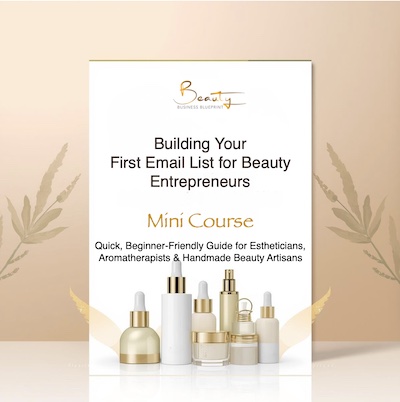
If building an email list feels confusing or technical, I created a beginner-friendly mini course called Building Your First Email List for Beauty Entrepreneurs.
It explains the process in plain language and walks you through each step calmly—without overwhelm.
Let’s simplify this.
You DO need:
– A clear audience (who you help)
– One focused offer (not a full product line)
– A way to collect email addresses
– A message rooted in education
You do NOT need:
– A complicated website
– Multiple products
– Paid ads
– Advanced tech skills
Many beauty entrepreneurs delay starting because they believe everything has to be perfect first.
In reality, clarity comes after movement—not before.
Many beauty entrepreneurs don’t need more motivation—they need clarity.

The Beauty Business Blueprint Workbook is designed to help you slow down, think intentionally, and map out your audience, offer, and direction before doing more.
This transition is subtle—but powerful.
In hands-on work, you solve problems one person at a time.
Online, you solve problems one question at a time—for many people.
Education becomes the bridge.
For example:
– Estheticians educate about skin concerns, routines, and consistency
– Aromatherapists educate about oil usage, emotional wellness, and safety
– Handmade beauty artisans educate about ingredients, formulation philosophy, and quality
When education leads, selling feels natural—not forced.
You’re not convincing.
You’re explaining.
If you prefer learning through reading, I’ve written two short, practical guides for beauty professionals:
– Selling Beauty Products Online
– The Esthetician’s Blueprint to Selling Beauty Products Online
Both explain the online selling process clearly and without hype.
View the guides here:
Stan.store/beautybusinessblueprint
Most roadblocks aren’t technical, they’re emotional.
Common ones include:
– Fear of being visible
– Feeling “late” to online business
– Not wanting to sound salesy
– Overthinking the process
– Comparing yourself to people with different goals
The truth is simple:
Your lived experience is your advantage.
Clients trust calm authority far more than loud marketing.
They trust professionals who explain, guide, and respect their intelligence.
A sustainable online beauty business usually follows this sequence:
Clarify who you help
1. Create one focused offer
2. Build an email list
3. Educate consistently
4. Sell with intention
This doesn’t happen overnight.
And it doesn’t need to.
Consistency, not speed, creates stability.
If selling beauty products online is something you want to explore seriously, the most effective approach is a guided one.
Instead of guessing, piecing things together, or trying to do everything at once, start with structured support that:
– Respects your pace
– Honors your experience
– Explains things in plain language
This is especially important if you’re transitioning from years of hands-on work into a digital environment.
If this article resonates with you and you’re ready to take the next step—without pressure or overwhelm—I’ve created beginner-friendly resources designed specifically for beauty entrepreneurs.
Inside my resource library, you’ll find:
– A foundational mini course on building your first email list
– Practical guides that explain selling beauty products online clearly
– Workbooks to help you think through your business intentionally
You can explore these resources here:
Stan.store/beautybusinessblueprint
There’s no rush.
Start where you are.
Build intentionally.
And allow your expertise to support you beyond the treatment room, blending table, or studio.
This matters most:
You don’t need to become someone else to sell beauty products online.
You simply need to let what you already know work in a new way.
Is selling beauty products online realistic for service-based professionals?
Yes. Many estheticians, aromatherapists, and handmade beauty artisans successfully sell beauty products online by transitioning their knowledge into education-based offers, curated products, or focused product lines. The key is building systems that don’t rely solely on physical presence.
Do I need a large social media following to sell beauty products online?
No. Selling beauty products online does not require a large social media following. What matters more is having a clear audience, an educational message, and a way to build direct relationships—most often through an email list.
What is the best way for beauty entrepreneurs to start selling online?
The best place to start is by clarifying who you help, creating one focused offer, and building an email list. This allows beauty entrepreneurs to educate their audience and introduce products without overwhelm or constant posting.
Can aromatherapists and handmade beauty artisans sell products online the same way estheticians do?
Yes. While the expressions differ, the business model is the same. Estheticians, aromatherapists, and handmade beauty artisans all benefit from education-led marketing, audience ownership, and intentional product offerings.
What is the biggest mistake beauty professionals make when selling online?
The biggest mistake is trying to do too much at once—multiple products, platforms, and strategies—before building clarity and a direct connection with their audience.
Is an email list really necessary for selling beauty products online?
Yes. An email list allows beauty entrepreneurs to own their audience, educate consistently, and sell products without depending entirely on social media algorithms.
How many products should I launch with? This is one of the most common (and most paralyzing) questions asked when starting your beauty business online.
As an esthetician, handmade beauty artisan, or aromatherapist, you’re likely brimming with creative ideas — body butters, face masks, oil blends, scrubs, sprays — all of which you know people would love.
But here’s the truth:
Starting with fewer products is the smarter, more sustainable approach.
In fact, many successful indie brands launched with just one to three core products, and then expanded only after gaining traction, feedback, and sales data. Whether you’re blending in your kitchen or scaling a private-label formula, a lean product launch helps you stay focused and profitable from the start.
When you launch with a focused product line, your brand message becomes clear and compelling. It’s easier to tell your story, highlight ingredients, share before-and-after results, and speak to a specific skin concern or emotional need.
Compare these two launches:
-“We offer 12 handmade skincare products for all skin types.”
-“We help dry, sensitive skin glow again with our hero balm and calming face mist.”
Which one is easier to market? The second one. Why? Because it’s focused, specific, and resonates.
Each product requires its own ingredients, containers, labels, safety testing (depending on your region), and packaging. If you launch with 10 different SKUs, you’re increasing your startup costs, storage needs, and production complexity. I learned this the hard way. I’m shocked that I don’t have more gray hair than what’s already visible.
Instead, you can streamline your supplies, reduce waste, and avoid sitting on unsold inventory by launching just 1–3 well-developed products.
Launching lean allows you to gather real customer feedback early. You’ll quickly learn:
-What customers love
-What packaging or scent they prefer
-What’s missing or could be improved
This helps you refine your existing offerings before investing time or money into more.
If you’re making handmade products or selling essential oil blends, you’ll also have to deal with proper cosmetic labeling, ingredient documentation, Good Manufacturing Practices (GMP), and batch tracking. The fewer products you have, the easier this becomes to manage. This is especially true in your early stages.
Here’s a simple guide for picking your launch SKUs based on your niche:
Start with a product that mirrors your in-person treatments:
-A post-treatment mask or balm
-A facial oil used during massage
-A mini retail version for home care
Consider a single hero product that solves a specific problem, such as:
-A “Glow Balm” for dry skin
-A natural deodorant with essential oils
-A whipped body butter for eczema-prone skin
Bundle it with a smaller size or a limited seasonal variation.
Begin with one or two essential oil blends:
-A calming bedtime roller blend
-A focus or energy blend in a diffuser bottle
-A mood-lifting inhaler or bath soak
Name them with emotion-forward branding like “Peace,” “Focus Flow,” or “Morning Calm.”
Instead of individual items, consider positioning your products as part of a routine or ritual:
-“The Bedtime Ritual Kit”
-“Glow in the Morning Duo”
-“Post-Facial Recovery Set”
This helps with both storytelling and increasing your average order value (AOV), while still keeping your SKU count low.
Launching with one to three products isn’t playing small, it’s playing smart.
By starting lean, you minimize risk, maximize clarity, and build a solid brand foundation that can grow with you. Whether you’re blending your first serum or curating your signature essential oil kit, your success doesn’t depend on having more. It depends on making what you offer truly matter to your ideal customer.
Building a beauty business online doesn’t require hustle or hype, it requires understanding, intention, and the right foundation. Download Your Free Guide to learn more.
At Beauty Business Blueprint, I teach beauty professionals how to turn what you already know into a business that supports your life, not overwhelms it.
That’s it for this week.
Juliette Samuel
Beauty Business Blueprint
Beauty products, online brand? If you’ve ever thought, “I’d love to sell beauty products online, but I don’t even know where to start,” you’re not alone. Many talented estheticians, aromatherapists, and handmade beauty artisans stay stuck for months — sometimes years — because the online world feels overwhelming.
You might already have amazing products, years of hands-on expertise, or a deep passion for beauty. However, the leap from “I make it” to “I sell it successfully online” can feel like a giant, confusing puzzle.
That’s exactly why I wrote Selling Beauty Products Online: How to Turn Your Passion for Beauty Products into an Online Business. Think of it as your friendly, step-by-step guide to building a beauty brand that works for you. That holds true even if you’re starting completely from scratch.
Selling beauty products online is more than just uploading a few pictures and waiting for orders to roll in. It’s about creating a system that:
– Attracts the right customers — people who actually want and value what you sell.
– Builds trust and brand recognition — so your business stands out in a crowded market.
– Converts interest into consistent sales — turning browsers into loyal buyers.
I’ve seen far too many beauty entrepreneurs waste months (and plenty of money) trying to figure it out through trial and error. My book helps with the process. It introduces you to clear, doable steps so you can skip the frustration and get to the results faster.
Here’s a sneak peek at what’s waiting for you in Selling Beauty Products Online:
1. The Difference Between Content and Copywriting (And Why Both Matter)
Content builds relationships. Copywriting drives sales. You need both, and I’ll show you how to use each effectively to grow your brand without feeling like you’re constantly “selling.”
2. How to Choose What to Sell
Should you sell your own handmade creations, partner with a dropshipping supplier, or start with affiliate products? Each has pros and cons. I walk you through them so you can choose what works best for your goals and lifestyle.
3. The Basics of Setting Up an Online Presence
From choosing a domain name to creating a professional-looking website, you’ll learn the essential first steps to establishing your beauty business online.
4. Building Your Email List from Day One
Your email list is your business’s most valuable asset. I’ll show you how to start growing it immediately — even if you don’t have a website yet — so you can connect directly with customers and make sales without depending solely on social media.
5. Easy Ways to Use Social Media Without Feeling Pushy
Social media can feel like a chore if you’re not sure how to approach it. In the book, I share strategies for showing up consistently, sharing value, and making sales without feeling like you’re shouting “buy now” every five seconds.
6. What to Outsource and When to Keep Control
You can’t do everything yourself forever. I’ll help you decide when it makes sense to outsource tasks and when you should keep things in-house to protect your brand’s quality and vision.
7. A 25 Page Glossary
Why so many pages? When you’re new to a given subject, learning the language is crucial to understanding it in detail. The internet is not different. As a matter of fact, it’s more important because a lot of words will be used that are not in your everyday vocabulary. So I’m sharing a lot of them with you. You will possibly still feel overwhelmed, but that’s okay. Keep moving forward.
This guide is for anyone ready to build a beauty brand online — whether you’re:
You don’t need to be a tech expert, a marketing guru, or have a giant budget. All you need is the willingness to start and the right steps to follow.
Take the First Step
Here’s the truth: you don’t have to wait until “everything is perfect” to start selling beauty products online. You can begin with what you have, learn as you go, and grow from there.
Selling Beauty Products Online is designed to be your launchpad. Acting as a guide to help you through the setup, avoid common mistakes, and show you what to do next.
Whether your goal is to create a side income or build a full-time beauty business, you’ll walk away with a clear plan and the confidence to put it into action.
📗 Buy on Amazon – Available in Paperback and Kindle
If you’ve been sitting on your dream because you didn’t know where to start, this is your sign. The beauty industry is waiting for your unique touch. The sooner you start, the sooner you can see your products in the hands (and hearts) of your ideal customers.
That’s it for this week. As always …
Dedicated to Your Success!
Juliette Samuel,
Esthetician/Aromatherapist/Publisher,
An esthetician’s blueprint? As an esthetician, you already know the value of recommending the right products to your clients. It’s part of your expertise. You guide them toward solutions that help them maintain their results between visits. But here’s the thing: your reach doesn’t have to stop at the treatment room.
With The Esthetician’s Blueprint for Selling Beauty Products Online, I walk you step-by-step through how to expand your retail sales into the online space. That way, you can reach clients anywhere, create more consistent income, and free yourself from depending solely on appointment hours.
Too many estheticians rely only on in-person sales. That works fine when your appointment book is full, but what happens during slow seasons, holidays, or unexpected closures? (Covid taught you a thing or two about unexpected closures). Income drops, stress rises, and your business stability takes a hit.
An online sales system changes that. By selling your favorite professional products, private-label items, or carefully chosen retail selections online, you create a new stream of income that works for you 24/7.
You’re no longer tied to the treatment room for every dollar you earn. This book shows you how to start building that system, even if you’ve never sold online before.
Inside The Esthetician’s Blueprint for Selling Beauty Products Online, you’ll discover:
– How to choose the perfect product mix for online sales – Identify pain points of your clients and that will be the beginning of your product mix. You don’t need a lot of SKU’s
– How to set up your online store or sales platform – From professional eCommerce websites to easy plug-and-play store options, you’ll learn the pros and cons so you can choose what’s right for your business.
– Social media strategies that actually work for estheticians – Learn how to create content that educates, inspires, and converts followers into paying customers.
– Email marketing basics for consistent sales – Build a simple email list that keeps your products in front of your clients without being pushy.
This book is designed for licensed estheticians who want to create or expand their retail sales online without losing focus on their core service business. Whether you’re brand new to selling products or already have a small retail corner in your treatment space, this blueprint gives you the tools to scale your sales and reach clients far beyond your local area.
Picture this, you wake up in the morning, check your phone, and see multiple order notifications , all from sales made while you were sleeping. No treatment time, no extra appointments, no waiting for the next busy season. Just consistent, reliable income flowing into your business.
That’s the power of selling beauty products online , and it’s completely possible for you.
If you’ve ever wanted to create a retail business that works alongside your esthetics practice, The Esthetician’s Blueprint for Selling Beauty Products Online is your starting point.
📗 Buy on Amazon – Available in Paperback and Kindle
That’s it for this week. As always …
Dedicated to Your Success,
Juliette Samuel,
Esthetician/Aromatherapist/Founder
What I wish I knew. When I first ventured into selling beauty products online, I thought I was prepared. I had great formulas, and a deep passion for skin care. My website was two years old and I had a few loyal clients that I’d built over time. I believed my experience as a new esthetician would naturally carry over into the world of ecommerce.
But I quickly learned that passion wasn’t enough.
The digital world plays by different rules, and I learned that the hard way. If you’re just starting out or feeling stuck, here’s what I wish someone had told me before I launched my online beauty brand. Get started the right way. Download this Free Guide.
I spent months obsessing over my labels, colors, logo, and packaging. I wanted everything to feel luxurious and professional. And while that effort wasn’t wasted, it also didn’t translate into immediate sales. By the way, those labels had no benefits or features worth noting.
Here’s the hard truth: beautiful branding only matters after someone finds you. And if no one knows your brand exists, your elegant packaging might as well be sitting in a drawer.
I realized that branding should support your marketing, not replace it. Start with clean, simple, cohesive visuals. However, don’t let the pursuit of “perfect” branding delay your launch. Get out there and let real feedback shape what needs refinement later.
When I started, I thought posting on Facebook, the go to platform at that time, a few times a week was enough. I figured that my product would speak for itself.
But there’s a difference between posting and marketing. You’ll find more on marketing in my book: Selling Beauty Products Online-How To Turn Your Passion for Beauty Products Into An Online Business
I didn’t understand things like keyword research, SEO, list segmentation, or how to write content that connected with real people. I didn’t know how to use tools like landing pages, analytics, or email automations to guide a customer journey.
It took time—and some hard lessons—to understand that online marketing is a craft. It requires study, experimentation, and strategy. If you treat it like an afterthought, your growth will stall.
Now, I approach it like a skill-set I’m always developing. Whether it’s writing better email subject lines or learning how to batch-create content, marketing is just as essential as your product itself.
At first, I tried to make products for “everyone with skin.” That felt safe and inclusive, but it made my messaging vague and ineffective.
It wasn’t until I got crystal clear on my audience … Black women with melanin-rich skin who wanted simple, natural solutions for dryness and hyperpigmentation … that things started to click. I could speak their language, address their pain points, and tailor my offers to what they were actually searching for.
Niche doesn’t mean limiting your success. It means focusing your energy so you can stand out in a noisy market.
Get specific. The more clearly you define who your products are for, the more effective your content, branding, and marketing will become.
In the beginning, can you actually believe that I ignored email marketing. I put all my focus on growing my Facebook followers and making my feed look nice. I didn’t realize I was building a house on rented land.
When algorithms changed or my reach dropped, I had no way to directly communicate with the people who had shown interest in my products. That not all that can happen when you only rely on social media platforms. My Facebook page was hacked, to the point where I couldn’t login and verify that I was the owner.
That’s when I started taking email seriously.
Now, I treat my list like a VIP community. I offer free downloads, share skincare tips, ask for feedback, and reward my subscribers with early access to sales and new products.
If you’re not building your list from day one, you’re missing one of the most valuable tools in your business.
In the beginning, I overthought everything. Every post, every product description, every newsletter had to be just right. I would spend hours tweaking one image or rewriting a blog post.
And while quality matters, perfectionism will paralyze you. I know this first hand.
The truth is, no one post, email, or product launch will make or break your business. What moves the needle is showing up consistently. Learning out loud. Taking imperfect action.
Your audience wants to grow with you. They want to trust you. And that trust is built over time, not from flawless posts, but from a steady presence.
Selling beauty products online is deeply rewarding, but it’s also humbling. It requires more than just great products. It demands clarity, consistency, and connection.
If you’re in the early stages, focus on visibility over vanity, relationships over perfection, and marketing over mere aesthetics. You can always refine your visuals late. However, without strategy and substance, beautiful packaging won’t move the needle.
Start now. Learn as you go. And remember, you’re not behind, you’re just getting started the right way.
That’s it for this week. As always …
Dedicated to Your Success,
Juliette Samuel,
Esthetician/ Aromatherapist/Founder,
Most handmade beauty artisans start with passion. It’s often sparked by a love for natural products, self-care rituals, or a personal skin care journey. Like many, I began by trying my hand at making a product or two. I quickly learned that it’s not as simple as mixing oils and butters and calling it a day. In fact, my biggest growth came from my biggest mistakes.
If you’re a handmade beauty artisan (or aspiring to be one), here are the top mistakes I’ve made—or seen others make—and how you can avoid them.
The Mistake: Believing you have to formulate every ingredient from the ground up.
My Experience: I did better with essential oil-based products. I could work more confidently using pre-made butter bases—like shea or mango—that I didn’t have to manipulate much.
Avoid It: Start simple. Use quality bases and build from there. You don’t need to be a chemist overnight. Focus on what you do well and grow your skill set over time.
The Mistake: Making products at home and selling them without proper preservation or testing.
Avoid It: Always test your products for safety—especially if they contain water (which can grow mold and bacteria). Learn about preservatives, shelf life, and how to conduct basic microbial testing. A product that feels “natural” should still be safe and stable.
The Mistake: Making products for “everyone.”
Avoid It: Get specific. Are you creating skincare for dry, aging skin? Products for teen acne? Beard balms for men with coarse hair? When you understand who you’re helping, you can speak directly to their needs—and your products will sell themselves.
The Mistake: Launching with 10+ products, hoping something sticks.
Avoid It: Start with 2–3 solid offerings. Focus on hero products you can master and scale. Trust me, it’s easier to refine your process and build loyal customers with a clear focus.
The Mistake: Pricing based on what you think people will pay—not what it costs to make and sell.
Avoid It: Factor in ingredients, time, packaging, branding, shipping—and yes, your profit margin. You’re not just selling a jar of butter. You’re selling value, wellness, and a brand experience.
The Mistake: Assuming good product alone is enough.
Avoid It: Your branding is the first thing people see. Invest in clear, professional labels. Create a name and message that resonates. People do judge the book by its cover—especially in the beauty world.
The Mistake: Waiting for things to be perfect before launching.
Avoid It: You will mess up—and that’s part of the journey. I screwed up plenty, but every mistake was a stepping stone. The real failure is not trying.
Your path as handmade beauty artisans won’t be flawless, but that’s okay. Every misstep teaches you something valuable. Whether you’re just starting or stuck in the messy middle, remember: progress beats perfection. And the most successful artisans? They’re the ones who keep learning, improving, and showing up.
That’s it for this week. As always, we’re ….. Grab your Free Download: Start Selling Beauty Products Online
Dedicated to Your Success,
Juliette Samuel,
Esthetician, Aromatherapist, Publisher,
Let’s be honest, overwhelm seems baked into the process of starting any kind of online business. Especially when you’re a beauty creator trying to navigate websites, social media, product descriptions, shipping logistics, email lists, and customer service. All while still making the products? Sound familiar?
I get it. I’ve been there. In fact, the idea of launching my beauty products online without overwhelm felt laughable at first. Like you, I asked myself: Am I just not organized enough? Do I need to wait until everything is perfect?
The truth is, running your beauty business online without overwhelm is possible, but only when you stop trying to do everything at once.
This article will help you break it down, clear the chaos, and take your next best step forward.
Overwhelm doesn’t mean you’re doing something wrong. It usually means you’re trying to do too much, too fast, with too little support or strategy.
Here are the top 5 reasons beauty creators like you feel buried under it all:
Trying to be everywhere online (Instagram, Facebook, Pinterest, TikTok, Etsy, Shopify… whew!)
Building a brand without clarity – You’re not sure what makes your brand unique or who your audience really is.
DIY-ing every tech piece – From websites to email marketing, the tech can feel like another language.
No plan for sales or marketing – Posting on social isn’t a strategy. It’s a tool within one.
Perfectionism and procrastination – Waiting to have the “perfect” label, logo, or product line stalls your momentum.
Pick one platform to focus on. One product to sell. One audience to speak to. You’re not Amazon. You’re building a boutique experience, lean into it.
Example: Instead of building a full Shopify store with 15 products, start with one hero product and sell it through Instagram + a simple ConvertKit landing page or Gumroad link.
If your goal is to help women with melanin-rich skin conquer dark spots, own that. Speak directly to that woman. Everything else—your content, branding, product design—gets easier once you know who you’re helping and why.
Quick exercise: Fill in the blank—
“I help [who?] with [what beauty challenge?] using [your product or approach].”
You don’t need a full email funnel or chatbot. But you do need something that works while you sleep. Set up a simple opt-in form to collect emails and deliver a freebie, coupon, or skin care tip sheet. Automation builds momentum.
Use tools like:
ConvertKit for email
Canva for design
Later or Metricool to pre-schedule posts
Block 3–4 focused hours per week for your business:
1 hour = making content (1–3 posts)
1 hour = customer service/orders
1 hour = planning or learning
Optional hour = batching product or packaging
Consistency beats chaos.
You can build a simple, profitable online beauty business by staying focused, consistent, and aligned with your values. Keep your customer experience warm and personal. Don’t get lost in shiny-object syndrome.
Yes, overwhelm is real, but it doesn’t have to define your beauty business journey. The goal isn’t to be perfect. The goal is to keep showing up, take small steps, and build a business that supports your creativity, not drains it.
So if you’re standing in your kitchen surrounded by labels, oils, and a half-written caption wondering if this is worth it—it is.
Just start with what you can do today. Let tomorrow be a continuation, not a new mountain to climb.
That’s it for this week. As always we’re …
Dedicated to Your Success,
Juliette Samuel,
Esthetician/Aromatherapist/Publisher,
Creating content for trust and authority? In a world overflowing with beauty products, what sets your brand apart isn’t just the perfect serum, balm, or essential oil blend—it’s how you communicate your expertise, values, and authenticity.
Content is more than just social media buzz. It’s every word, image, and video that tells your story—from your website and blog to your product labels and tutorials.
If you’re building a beauty brand online, your content should do one thing above all: build trust and establish your authority in your niche.
Your customers are looking for guidance. Whether it’s understanding the difference between a serum and a facial oil, or learning how to use a gua sha tool with your botanical balm—they want to know what you know.
Examples:
– Blog post: “The Best Essential Oils for Hyperpigmentation”
– Video: “How to Layer Your Skincare Products the Right Way”
– Instagram carousel: “3 Ways to Use a Hydrosol in Your Daily Routine”
🪄Tip: Think like a teacher. Educate with generosity—it builds trust faster than any fancy marketing language.
Customers buy from people they trust and people they feel like they know. Show them what goes on behind the curtain of your handmade beauty brand. Let them see the care, intention, and ethics that go into every jar or bottle.
Examples:
– IG Stories or blog post about sourcing ingredients
– Time-lapse video of a product being hand-poured or labeled
– Photo essay on your workspace or packaging setup
Why it works: Transparency earns loyalty. It’s also a powerful way to highlight your brand values.
Side Note: If your work space is a mess, don’t put it on camera. Transparency is one thing but a messy, dirty space, will not entice anyone to purchase your beauty products.
People trust people. That’s why testimonials, reviews, and user-generated content (UGC) are gold.
Examples:
– “Before and after” skin transformations using your product
– Screenshot of a glowing customer email or review
– Reposted content from a happy client who tagged you
Pro Tip: Include this content on your product pages and blog, not just social. That way, even people who don’t follow you on Instagram get the reassurance they need.
Why did you start your brand? What makes you passionate about handmade skincare or aromatherapy? Your origin story is magnetic—but don’t stop there. Use storytelling to connect your products to moments in your customers’ lives.
Examples:
– A blog post about how eczema inspired your first product
– Email story: “This Calming Oil Was Born During My Own Menopause Journey”
– About page that tells your founder story with photos and heart
📣Reminder: Storytelling works everywhere: in product descriptions, welcome emails, and even packaging copy.
Think of the problems your customers face—then create content that solves them. When you consistently offer real solutions, you become a trusted advisor, not just a seller.
Examples:
– Guide: “How to Choose the Right Cleanser for Dry, Mature Skin”
– Video: “3 Ways to Soothe a Hormonal Breakout Naturally”
– Blog post: “Dealing with Fragrance Sensitivity? Here’s What to Know”
🔍SEO Bonus: This type of content also performs well in search engines, bringing organic traffic to your website.
Yes, Instagram, Facebook, and TikTok matter, but they’re not enough. True brand authority is built on owned content. What is owned content? Your blog, website, email list, and product descriptions. These platforms are where people land when they’re ready to buy, research, or return.
Make sure your content is:
– Well-written
– On-brand
– Informative
– Optimized for your ideal client
Want to start small? Choose one of these content types and create a weekly post on your blog or a tip series via email. Build consistency, and watch your trust factor grow.
That’s it for this week. As always, we’re …
Dedicated to Your Success,
Juliette Samuel,
Esthetician/Aromatherapist, Publisher,