

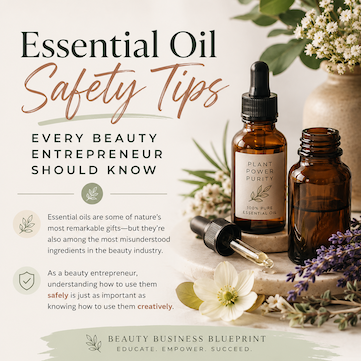
Essential Oil Safety Tips Every Beauty Entrepreneur Should Know
“Essential oils are some of nature’s most remarkable gifts, but they’re also among the most misunderstood ingredients in the beauty industry. As a beauty entrepreneur, understanding how to use them safely is just as important as knowing how to use them creatively.”
Beautiful Products Begin With Safe Formulations
Essential oils have become increasingly popular in skin care, body care, hair care, soaps, candles, and natural perfumes. Consumers are drawn to their beautiful aromas and appreciate the botanical story behind many handmade beauty products.
As an aromatherapist and beauty entrepreneur, I’ve seen firsthand how essential oils can elevate a product when they’re used with knowledge and care.
Unfortunately, I’ve also seen well-meaning entrepreneurs believe that because an ingredient is “natural,” it must automatically be safe.
That simply isn’t true.
Essential oils are highly concentrated plant extracts. Some require hundreds—or even thousands—of pounds of plant material to produce a relatively small amount of oil. Their potency is what makes them so valuable, but it’s also why they must be handled responsibly.
Whether you’re creating facial serums, body butters, soaps, perfumes, or massage oils, understanding essential oil safety is one of the most important investments you can make in your business.
Safe products build trust.
Trust builds loyal customers.
Let’s explore the essential safety practices every beauty entrepreneur should know.
Essential Oils Are Powerful, Not Harmless
One drop of essential oil contains a remarkable concentration of naturally occurring chemical constituents.
That concentration is why essential oils are widely used in aromatherapy and personal care products.
However, more is not necessarily better.
Using excessive amounts of essential oils can increase the risk of:
- Skin irritation
- Allergic reactions
- Sensitization
- Headaches
- Respiratory discomfort
- Eye irritation
Many new formulators mistakenly assume that adding extra essential oil will make a product more effective or luxurious.
In reality, thoughtful formulation almost always produces a better product than simply increasing the fragrance level.
Understand Proper Dilution
One of the most important principles in essential oil safety is proper dilution.
Essential oils should rarely be applied directly to the skin without careful consideration, and they are generally incorporated into carrier oils, creams, lotions, or other cosmetic bases.
Different products call for different usage rates.
For example:
- Facial products often use lower concentrations because facial skin is more delicate.
- Body products may tolerate slightly higher concentrations.
- Products intended for children, older adults, or individuals with sensitive skin generally require more conservative formulations.
Learning recommended usage levels for each essential oil—and for each type of product—is a hallmark of a responsible formulator.
When in doubt, less is often more.
Not Every Essential Oil Belongs in Every Product
Choosing essential oils should never be based solely on fragrance.
Each oil has its own aromatic profile, skin considerations, and formulation characteristics.
For example:
- Some oils are better suited for facial products.
- Others work well in massage oils or body care.
- Some oils are known for uplifting aromas.
- Others are valued for calming or grounding qualities.
Think beyond scent.
Ask yourself:
- Does this essential oil support the purpose of my product?
- Is it appropriate for my intended audience?
- Does it complement the other ingredients?
Professional formulation always begins with purpose.
Be Aware of Phototoxic Essential Oils
One topic that deserves special attention is phototoxicity.
Certain citrus essential oils can increase the skin’s sensitivity to ultraviolet (UV) light if they are used above recommended levels in leave-on products.
This means that a product applied before sun exposure could increase the risk of skin irritation or discoloration.
Not every citrus oil presents the same level of concern, and processing methods can affect phototoxicity. Understanding the specific properties of each oil is an important part of responsible formulation.
If you’re creating products that are designed to remain on the skin, research phototoxicity carefully and formulate accordingly.
Your customers are trusting you with their skin.
Store Essential Oils Properly
Essential oils can change over time.
Exposure to:
- Heat
- Light
- Air
- Moisture
can accelerate oxidation, reducing the quality of the oil and potentially increasing the likelihood of skin irritation.
Store essential oils in:
- Dark glass bottles
- Cool environments
- Tightly sealed containers
Label every bottle with:
- Name
- Botanical name
- Purchase date
- Supplier
- Batch information
Good storage practices help preserve both quality and consistency.
Buy From Reputable Suppliers
The quality of your finished product depends on the quality of your ingredients.
Choose suppliers who provide:
- Botanical names
- Country of origin
- Batch information
- Recommended storage guidance
- Transparency regarding testing and quality standards
Low-cost essential oils that lack documentation may not provide the consistency or quality you need for professional product formulation.
Quality ingredients contribute to customer confidence.
Patch Testing Matters
Even thoughtfully formulated products may not be suitable for every individual.
People have different skin sensitivities, allergies, and medical conditions.
Encouraging customers to perform a simple patch test before using a new product demonstrates professionalism and care.
It also reinforces that skin care is personal.
One product does not work identically for everyone.
Helping customers understand this builds trust rather than unrealistic expectations.
Label Products Clearly
Clear labeling is an important part of product safety.
Include information such as:
- Product name
- Directions for use
- Ingredient list
- Storage recommendations
- Appropriate cautions where needed
Well-written labels answer questions before customers have to ask them.
They also reflect the professionalism of your brand.
Never Stop Learning
Essential oil research continues to evolve.
New information becomes available regarding formulation practices, ingredient interactions, and consumer safety.
As beauty entrepreneurs, we have a responsibility to continue learning.
Invest in books.
Take formulation courses.
Study cosmetic science.
Expand your understanding of carrier oils, botanical extracts, preservatives, emulsifiers, and ingredient compatibility.
Education protects both your customers and your business.
Beauty Business Blueprint Tip
One of the greatest compliments your customers can give you isn’t, “Your products smell amazing.”
It’s:
“I trust your products.”
That trust comes from thoughtful formulation, honest education, responsible labeling, and a genuine commitment to customer well-being.
Beautiful branding may attract a first purchase.
Safe, reliable products encourage customers to return again and again.
Your Reputation Is Built One Product at a Time
Every jar, bottle, and serum you create represents your brand.
When customers choose your products, they’re placing their confidence in your knowledge and professionalism.
That’s a responsibility worth taking seriously.
By understanding essential oil safety, investing in quality ingredients, and continuing your education, you’re doing more than creating beautiful products.
You’re building a business based on integrity.
And in today’s beauty industry, integrity is one of the most valuable ingredients you can offer.
Whether you’re an aromatherapist, esthetician, handmade beauty artisan, or aspiring beauty entrepreneur, remember this:
The goal isn’t simply to create products people enjoy.
The goal is to create products they can trust.
That’s how lasting beauty brands are built.
Ready to Build Your Beauty Business on a Strong Foundation?
If you’re serious about creating and selling natural beauty products online, begin with a business strategy that supports your creativity.
Selling Beauty Products Online: The 9 Core Elements to Help You Get Started.
Inside, you’ll discover the essential business principles that help beauty entrepreneurs move beyond product making and begin building brands that educate, inspire, and serve customers with confidence.
Your knowledge is one of your greatest business assets. Build your brand on it.
That’s it for this week,
Honor Your Craft.
Build Your Online Business.
Juliette Samuel,
Where Beauty and Business Meet.