

I Don’t Know Where to Start With My Beauty Business
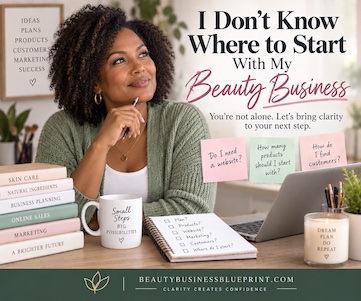
Starting a beauty business online? You have the idea. Maybe you’ve even had it for years.
You know you want to start a beauty business. Perhaps you’re an esthetician who wants to sell products online.
Maybe you’re an aromatherapist with formulas you’ve been creating for friends and clients. You might make soaps, body butters, hair oils, candles, fragrances or other handmade products.
Or maybe you simply have years of beauty knowledge and experience and know you’re ready to turn some of that knowledge into a business.
There’s just one problem:
You don’t know where to start.
And every time you try to figure it out, you seem to end up with even more things to do.
Someone tells you that you need a website.
Someone else says you should start on Instagram.
Then you hear that you need an email list.
A logo.
You need packaging.
An LLC.
You need a sales funnel.
You need to learn SEO.
And, You definitely need to make videos.
And, of course, now everyone is telling you that you need AI.
Before long, your original excitement about starting a beauty business has turned into a very long to-do list.
Here’s what I want you to understand:
You don’t have to do everything at once.
You simply need to know what comes first.
The Problem Isn’t That You Don’t Know Enough to Start Your Beauty Business
One of the biggest mistakes beginning beauty entrepreneurs make is assuming you need more information.
So you start collecting it.
Another YouTube video.
Another podcast.
A free download.
More webinars.
And definitely, another course.
Oh and, Another expert telling you how they built a six- or seven-figure business.
There is certainly nothing wrong with learning. In fact, learning will always be part of building a business.
But there comes a point when more information doesn’t create more clarity.
It creates overwhelm.
You don’t necessarily need another 47 things to add to your list.
You need a starting point.
Start With the Business, Not the Technology
This is where I see many aspiring beauty entrepreneurs get stuck.
They begin asking questions such as:
Which website platform should I use?
Should I use Shopify?
What email software should I buy?
Should I be on TikTok?
Do I need a Facebook page?
Should I create a YouTube channel?
What AI tools should I use?
Those questions matter eventually.
But they’re not necessarily your first questions.
Before you start choosing technology, you need to understand the business that technology is supposed to support.
Start with questions like:
-Who am I trying to help?
-What problem am I helping them solve?
-What am I going to sell?
-Why would someone choose my product or service?
-How will I reach the people who are most likely to need it?
Those answers become the foundation for many of the decisions that come later.
Who Are You Really Trying to Help?
Let’s say you want to create natural skin care products.
That’s a beginning, but it’s still very broad.
Who are those products for?
Women with mature skin?
Women with melanin-rich skin who are concerned about uneven skin tone?
Teenagers experiencing oily skin and breakouts?
Busy professional women who want a simple skin care routine?
People with dry, sensitive skin?
Those are very different customers.
And they may require different products, different messaging and different ways of reaching them.
This is why knowing your ideal customer isn’t just a marketing exercise.
It helps you make better business decisions.
When you know who you’re trying to help, you can begin asking:
What does she need?
That’s a much better starting question than:
What can I make?
Your Product Doesn’t Have to Come First
Beauty professionals love products.
That’s understandable.
You’re creative. You may enjoy working with ingredients, textures, essential oils, colors, fragrances and formulations.
So it’s very tempting to begin with the product.
You formulate six body butters.
Order 100 jars.
Have beautiful labels printed.
Create a logo.
Pay someone to build a website.
And then you arrive at the question that should have been asked much earlier:
Who am I selling this to?
That’s when marketing becomes difficult.
You’re trying to find a customer for something you’ve already created rather than creating an offer around a customer you’ve taken the time to understand.
The order matters.
You Don’t Need a 50-Page Business Plan to Begin
The words business plan can make starting feel even more intimidating.
You might imagine complicated spreadsheets, financial projections and a thick document that looks as though it belongs in a banker’s office.
Your business planning can become more detailed as your business grows.
But at the beginning, you need clarity.
Try answering these five questions:
- Who do I want to serve?
- What problem or need will my business address?
- What will I sell?
- How will people find me?
- How will the business make money?
Don’t worry about making your answers perfect.
Write them down.
Seeing your thoughts on paper can reveal gaps that are difficult to see when everything is swirling around in your head.
What If You’ve Already Started?
Maybe you’re reading this thinking:
“It’s too late. I’ve already bought products.”
Or:
“I already paid for my website.”
That’s okay.
Starting out of order doesn’t mean you have to throw everything away and begin again.
It simply means it’s time to stop adding things for a moment and examine the foundation underneath what you’ve already built.
Ask yourself:
Do I clearly know who my customer is?
Does my product solve a specific problem or meet a specific desire?
Can I explain what makes my business different?
Do I know how I’m going to attract potential customers?
Do I have a way to continue communicating with people who aren’t ready to buy today?
If several of those answers are “no,” you’ve just discovered where some of your work needs to begin.
That’s useful information.
Stop Comparing Your Beginning to Someone Else’s Middle
This is especially important today.
Social media allows us to see the polished version of everybody else’s business.
You see the beautiful packaging.
The professional videos.
The warehouse.
The thousands of followers.
The launch that supposedly generated thousands of dollars.
What you usually don’t see are all the steps that happened before that moment.
You don’t see the mistakes.
Nor do you see the product that didn’t sell.
You don’t see the website that had to be rebuilt.
You don’t see the money that was spent on things that didn’t work.
And you certainly don’t see every hour that went into building the business.
It isn’t Your job to reproduce someone else’s business.
Your job is to build your business in the right order.
Your Experience May Be More Valuable Than You Think
This is especially important if you’re coming into entrepreneurship later in life or after years of working in the beauty industry.
You may be looking at all the new technology and thinking you’re behind.
But you may have something the newest technology can’t manufacture overnight:
experience.
Perhaps you’ve worked with clients for 10, 15 or 20 years.
You’ve listened to their questions.
You know what confuses them.
You’ve watched them struggle with certain problems.
You know what they repeatedly purchase.
You know what they ask when nobody else is listening.
Don’t discount that knowledge because you haven’t figured out Instagram or built your website yet.
Your experience can help you identify a customer need.
Technology can then help you deliver the solution.
That’s a very different way of approaching an online business.
Give Yourself Permission to Start and Build Your Beauty Business Slowly
There is tremendous pressure online to move fast.
Launch this weekend.
Make your first $10,000 in 30 days.
Post three times a day.
Build seven income streams.
Automate everything.
But speed without clarity can become expensive.
There is nothing wrong with taking the time to understand what you’re building before you begin spending heavily to build it.
That doesn’t mean remaining in the planning stage forever.
It means taking the next appropriate step instead of trying to take 20 steps at once.
Your first goal doesn’t have to be creating an empire.
Your first goal can simply be:
Get clear.
Then move.
Learn from what happens.
Adjust.
And take the next step.
So, Where Should You Start?
Start with your foundation.
Before worrying about whether you need another social media platform, another piece of software or another product, make sure you understand the core elements of the business you’re trying to create.
Who is your customer?
How will she find you?
What does she need?
How will you position it?
What are you offering?
How will you communicate with her?
How will you turn interest into a sale?
Those aren’t glamorous questions.
But answering them can save you an enormous amount of frustration, time and money later.
And that’s exactly why I created the 9 Core Elements to Help You Get Started Selling Beauty Products Online.
It’s not designed to give you another pile of information to consume.
It’s designed to help you think through your business.
You’ll work through the fundamental questions that can help you identify what you already know, what you still need to figure out and what deserves your attention next.
Because when you’re saying:
“I don’t know where to start,”
the answer isn’t to start everywhere.
It’s to start with the foundation.
Ready to Find Your Starting Point?
Download your free copy of 9 Core Elements to Help You Get Started Selling Beauty Products Online and begin working through your business one element at a time.
GET THE 9 CORE ELEMENTS — FREE
Beauty Business Blueprint — Because Clarity Creates Confidence.
That’s it for this week,
Honor Your Craft. Build Your Online Business.
Juliette
Where Beauty and Business Meet.