

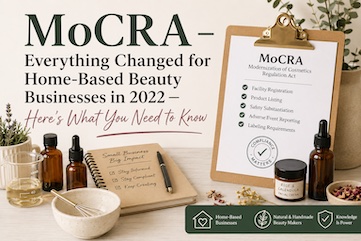
MoCRA – Everything Changed for Home-Based Beauty Businesses in 2022 — Here’s What You Need to Know
If you’ve been thinking about making, or making and selling handmade beauty products — whether that’s a luxurious body butter, an artisan soap, or a custom face serum — you’ve probably heard rumblings about new regulations.
Did someone in a Facebook group mentioned it? Maybe a fellow maker warned you. Maybe you Googled it at midnight and ended up more confused than when you started.
Here’s the thing, something genuinely did change. And if you sell cosmetics in the United States — handmade or otherwise — it affects you.
The good news? It’s not as overwhelming as it sounds. And You, the artisans, who understand these changes are the ones who’ll build businesses that last.
Let’s break it down.
The Law That Rewrote the Rules: MoCRA
In December 2022, Congress passed the Modernization of Cosmetics Regulation Act — known as MoCRA. It was signed into law as part of the Consolidated Appropriations Act and represents the most significant update to cosmetics regulation in the United States in over 80 years.
That’s not an exaggeration. The previous major legislation governing cosmetics dated back to 1938. For decades, the beauty industry — including the booming handmade and indie segment — operated under rules that were written before television existed.
Go Figure!
MoCRA changed that. And while large corporations have entire compliance departments to absorb these changes, independent artisans and home-based/handmade beauty businesses are often left navigating them alone.
That’s exactly why we need to talk about it.
The most significant update to cosmetics regulation in over 80 years — and most handmade, home-based and small beauty business artisans have never heard of it.
What MoCRA Actually Requires
MoCRA introduced several new requirements that apply across the cosmetics industry. Here’s what matters most for small and home-based beauty businesses:
1. Facility Registration. Businesses that manufacture or process cosmetic products are now required to register their facilities with the FDA. There is a small business exemption for companies below certain gross sales thresholds — but those thresholds can be updated, so it’s critical to verify your current status directly with the FDA or a qualified compliance professional rather than relying on secondhand information.
2. Product Listing. Even if you qualify for a facility registration exemption, you may still be required to submit a product listing to the FDA. This involves providing basic information about each product you sell — its name, the company behind it, and the ingredients it contains.
3. Safety Substantiation. This is one of the most important new requirements. MoCRA formally requires that cosmetic products be safe for their intended use. For artisans, this means having a reasonable, documented basis for the safety of your formulations — not just a good feeling about your ingredients. Sourcing from reputable suppliers, keeping clear records, and understanding your formulations are all part of this.
4. Labeling Compliance. Your product labels must meet FDA standards — and this goes beyond just listing ingredients. The order matters (ingredients must be listed by descending weight), required warnings must be included, and the claims you make about your product must stay within cosmetic territory. More on that below.
5. Adverse Event Reporting. This is a brand-new requirement with real teeth. If a customer experiences a serious adverse event — such as a significant allergic reaction — and reports it to you, you now have 15 business days to report that to the FDA. This requirement did not exist before MoCRA. If you’ve been selling for a while and didn’t know this, now you do.
The Word Problem: Cosmetic vs. Drug
Here’s where a lot of well-meaning artisans unknowingly get into trouble — and it’s not about their formulations. It’s about their words.
Under FDA regulations, the difference between a cosmetic and a drug comes down to the claims you make about your product. A cosmetic is something that cleans, beautifies, or alters appearance. A drug affects the structure or function of the body.
Sounds simple enough. But consider these examples:
“Moisturizes and softens skin” → cosmetic claim. You’re fine.
“Treats dry skin conditions” → drug claim. Your product may now be classified as a drug.
“Adds shine and smooths the hair cuticle” → cosmetic claim. Fine.
“Repairs hair damage at the cellular level” → potentially a drug claim. Problem.
This isn’t just about your label. It applies to your Etsy listing description, your Instagram captions, your website copy, your YouTube video titles — anywhere you describe what your product does.
You can have a perfectly formulated, beautifully packaged product and still run into regulatory trouble — because of a single word choice in your marketing copy.
The safest approach is to describe what your product does on the surface — how it feels, how it looks, the sensory experience — rather than making claims about what it does inside the body. When in doubt, err on the side of caution and consult a cosmetic regulatory professional before publishing.
So What Does This Mean for Your Home-Based Business?
MoCRA was written with the understanding that not every cosmetics business is Estée Lauder. There are exemptions and tiered requirements designed to make compliance achievable for small businesses.
But “achievable” is not the same as “optional.”
The artisans who will thrive in this new regulatory environment are the ones who treat compliance as part of their brand — not an obstacle to it. And honestly? There’s a real competitive advantage here. When your customers know that you take your craft seriously, that you’ve done the work to understand what goes into your products and how they’re sold, it builds the kind of trust that no Instagram ad can manufacture.
Here are the most practical places to start:
Know your INCI names. Every ingredient you use should be identifiable by its INCI name — the International Nomenclature of Cosmetic Ingredients. This is what goes on your label, in the correct order. If your supplier can’t provide this, find a supplier who can.
Keep records. Document your sourcing, your formulations, and any customer feedback. Good records aren’t just good business — they’re your first line of defense if you ever face a regulatory inquiry.
Audit your labels before you launch anything new. Your label is a legal document. Treat it accordingly. Review it against current FDA guidelines, and don’t assume what worked two years ago is still compliant today.
Stay current. MoCRA is still being implemented, and the FDA continues to release new guidance. Subscribe to FDA updates or follow trusted industry organizations so you’re not caught off guard.
The Bottom Line
Running a home-based beauty business has always required wearing a lot of hats. Formulator. Photographer. Marketer. Customer service rep. Shipper.
MoCRA just added one more hat to the rack: compliance-aware business owner.
It’s not the most glamorous part of the job. But it is one of the most important — and the most empowering, once you understand it. Because when you know the rules, you can build with confidence. You can scale without fear. You can put your products in the hands of customers knowing you’ve done everything right.
That’s not a burden. That’s a foundation.
And that foundation is exactly what I cover in depth in my book — Selling Beauty Products Online: How To Turn Your Passion For Beauty Products Into An Online Business. From FDA basics and MoCRA compliance, to labeling, pricing, building your store, and marketing your brand. It’s everything you need to go from passionate maker to confident business owner.
If you’re ready to take that next step, the link is below.
You’ve already got the talent. Now let’s make sure you’ve got the knowledge to back it up.
Ready to go deeper? Check out pages 44-57 in the book.
Selling Beauty Products Online: How To Turn Your Passion For Beauty Products Into An Online Business covers FDA compliance, MoCRA, labeling, pricing, building your online store, and everything in between — written specifically for independent beauty artisans.
That’s it for this week,
Honor Your Craft. Build Your Online Business.
Juliette Samuel,
Where Beauty and Business Meet.